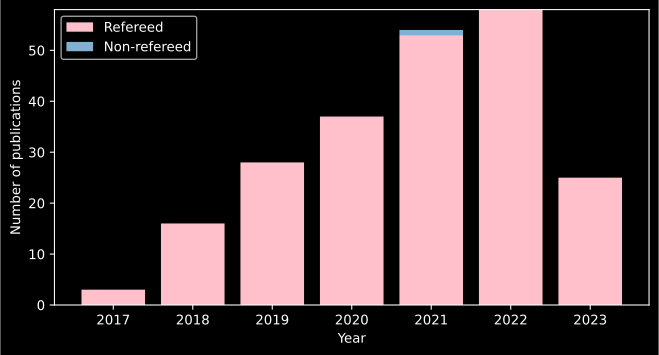
This page is automatically generated from an ADS Libary maintained by the GALAH team.
Jump to a year:
2026
- The Diversity of Cold Worlds: Age and Characterization of the Exoplanet COCONUTS-2 b
Kiman et al. (2026) AJ 171 60 (doi:10.3847/1538-3881/ae230f, arXiv:2511.20923) - Connecting JWST discovered N/O-enhanced galaxies to globular clusters: evidence from chemical imprints
Ji et al. (2026) MNRAS 545 staf2110 (doi:10.1093/mnras/staf2110, arXiv:2505.12505) - Testing stellar yield prescriptions in OMEGA+: implications for rising sodium abundances in young thick disc stars
Owusu et al. (2026) MNRAS 545 staf2079 (doi:10.1093/mnras/staf2079, arXiv:2506.17711) - Gaia Barium Dwarfs and Their Ostensibly Ordinary Counterparts
Rekhi et al. (2026) ApJL 996 L37 (doi:10.3847/2041-8213/ae286c, arXiv:2509.13413) - Scalable Stellar Parameter Inference Using Python-based LASP: From CPU Optimization to GPU Acceleration
Liang et al. (2026) ApJ 996 97 (doi:10.3847/1538-4357/ae1446, arXiv:2512.24840) - The Gaia─Kepler─TESS-host Stellar Properties Catalog: Uniform Physical Parameters for 10022 Host Stars and 10189 Planets
Berger et al. (2026) AJ 171 23 (doi:10.3847/1538-3881/ae0e76)
2025
- Unlocking i-process nucleosynthesis by bridging stellar and nuclear physics
Wiedeking et al. (2025) NatRP 7 696 (doi:10.1038/s42254-025-00885-7) - Fundamental effective temperature measurements for eclipsing binary stars ─ VI. Improved methodology and application to the circumbinary planet host star BEBOP-3
Maxted et al. (2025) MNRAS 544 4611 (doi:10.1093/mnras/staf1856, arXiv:2510.23218) - SPYGLASS. VII-A. The Demographics and Ages of Small Nearby Young Associations
Kerr et al. (2025) ApJ 995 217 (doi:10.3847/1538-4357/ae1731, arXiv:2510.21936) - Advancing Stellar Parameter Estimation: Uncertainty-Aware Astrophysical Fusion Network for Red Giant Ages and Abundances from Ultra-low-resolution Spectra—Applications to Galactic Archaeology
Sun et al. (2025) ApJ 995 174 (doi:10.3847/1538-4357/ae1692) - From Underground Oceans to Continents: A Glimpse into the Water Inventory on Rocky Planets Using Host Star Abundances
Boley et al. (2025) ApJ 995 172 (doi:10.3847/1538-4357/ae182b, arXiv:2510.24854) - Stellar Loci. IX. Estimation of Stellar Parameters from CSST-like Photometry
Lu et al. (2025) ApJ 995 53 (doi:10.3847/1538-4357/ae17b7, arXiv:2511.00591) - Insights into Planet Formation from the Ages, Masses, and Elemental Abundances of Host Stars
Chen et al. (2025) ApJ 995 33 (doi:10.3847/1538-4357/ae12a2, arXiv:2510.10092) - Extending the [C/N]─Age Calibration: Using Globular Clusters to Explore Older and Metal-poor Populations
Spoo et al. (2025) AJ 170 333 (doi:10.3847/1538-3881/ae14ec, arXiv:2510.17579) - Identifying substructure associations in the Milky Way halo using chemo-kinematic tagging
Youakim and Lind (2025) A&A 704 A296 (doi:10.1051/0004-6361/202554934, arXiv:2510.26952) - Gaia DR3 high radial velocity stars: Genuine fast-moving objects or outliers?
Katz et al. (2025) A&A 704 A294 (doi:10.1051/0004-6361/202556602, arXiv:2603.02850) - The R-Process Alliance: Exploring the cosmic scatter among ten r-process sites with stellar abundances
Racca et al. (2025) A&A 704 A282 (doi:10.1051/0004-6361/202556947, arXiv:2510.25500) - Toward model-free stellar chemical abundances: Potential applications in the search for chemically peculiar stars in large spectroscopic surveys
Signor et al. (2025) A&A 704 A279 (doi:10.1051/0004-6361/202555376, arXiv:2511.09733) - Chronology of our Galaxy from Gaia colour─magnitude diagram fitting (ChronoGal): II. Unveiling the formation and evolution of the kinematically selected thick and thin discs
Fernández-Alvar et al. (2025) A&A 704 A258 (doi:10.1051/0004-6361/202553814, arXiv:2503.19536) - A kinematic history of stellar encounters with Beta Pictoris
Gragera-Más et al. (2025) A&A 704 A237 (doi:10.1051/0004-6361/202555940, arXiv:2510.02509) - WIde Separation Planets In Time (WISPIT): Two directly imaged exoplanets around the Sun-like stellar binary WISPIT 1
van Capelleveen et al. (2025) A&A 704 A221 (doi:10.1051/0004-6361/202556584, arXiv:2508.18456) - The AMBRE Project: Line-broadening and stellar rotation of ESO/FEROS archived spectra
Bado et al. (2025) A&A 704 A49 (doi:10.1051/0004-6361/202557176, arXiv:2510.23305) - The metal-poor tail of the APOGEE survey: I. Uncovering [Fe/H] < ─2.5 stars from the inner Galaxy to the Magellanic Clouds
Montelius et al. (2025) A&A 704 A44 (doi:10.1051/0004-6361/202556198, arXiv:2602.10859) - How well can we unravel the accreted constituents of the Milky Way stellar halo?: A test on cosmological hydrodynamical simulations
Thomas et al. (2025) A&A 704 A40 (doi:10.1051/0004-6361/202452449, arXiv:2504.10398) - Multiwavelength probes of the Milky Way’s cold interstellar medium: radio H I and optical K I absorption with GASKAP and GALAH
Nguyen et al. (2025) MNRAS 543 3474 (doi:10.1093/mnras/staf1663, arXiv:2509.23066) - Investigating the Upper Scorpius OB association with HERMES ─ I. The spectroscopic sample and 6D kinematics
Armstrong et al. (2025) MNRAS 543 2349 (doi:10.1093/mnras/staf1490, arXiv:2505.03716) - A new way to find symbiotic stars: accretion disc detection with continuum survey photometry
Lucy et al. (2025) MNRAS 543 2292 (doi:10.1093/mnras/staf1351, arXiv:2412.00855) - Four Elements to Rule Them All: Abundances Are Rigidly Coupled in the Milky Way Disk
Mead et al. (2025) ApJ 994 52 (doi:10.3847/1538-4357/ae0b64, arXiv:2504.18532) - Investigating Non-LTE Abundances of Neodymium in Metal-poor FGK Stars
Dixon et al. (2025) ApJ 994 44 (doi:10.3847/1538-4357/ae0b59, arXiv:2509.22811) - Optical Spectroscopy Reveals Hidden Neutron-capture Elemental Abundance Differences among APOGEE-identified Chemical Doppelgängers
Manea et al. (2025) ApJ 993 45 (doi:10.3847/1538-4357/adff75, arXiv:2508.16717) - Rare find: Discovery and chemo-dynamical properties of two s-process-enhanced RR Lyrae stars
D’Orazi et al. (2025) A&A 704 A12 (doi:10.1051/0004-6361/202557188, arXiv:2510.15723) - Proto-planetary disk composition-dependent element volatility in the context of rocky planet formation
Spaargaren et al. (2025) A&A 703 A218 (doi:10.1051/0004-6361/202556011, arXiv:2509.03724) - Lithium evolution in the Galactic thin disc from main-sequence and early red-giant-branch stars
Nguyen et al. (2025) A&A 703 A204 (doi:10.1051/0004-6361/202556562, arXiv:2508.14594) - First large-scale spatial and velocity patterns of local metal-rich stars in the Milky Way
Kordopatis et al. (2025) A&A 703 A151 (doi:10.1051/0004-6361/202556657, arXiv:2509.17420) - The GALAH survey: Improving chemical abundances using star clusters
Kos et al. (2025) A&A 703 A104 (doi:10.1051/0004-6361/202554112, arXiv:2501.06140) - The Bimodal Distribution of Donor Stars in X-Ray Binaries
Zhang et al. (2025) PASP 137 104202 (doi:10.1088/1538-3873/ae0369, arXiv:2510.14524) - Atmospheric parameters and chemical abundances of young stars with APOGEE ─ I. Orion star-forming region
López-Valdivia et al. (2025) MNRAS 543 420 (doi:10.1093/mnras/staf1445, arXiv:2508.20313) - Migration and Evolution of giant ExoPlanets (MEEP). II. Super-Jupiters and Lithium-rich host stars
Schulte et al. (2025) MNRAS 543 292 (doi:10.1093/mnras/staf1455, arXiv:2509.02666) - The highest mass Kepler red giants ─ II. Spectroscopic parameters, the amplitude─activity relation, and unexpected halo orbits
Crawford et al. (2025) MNRAS 542 3289 (doi:10.1093/mnras/staf1421, arXiv:2508.12585) - Local dark matter density from Gaia DR3 K-dwarfs using Gaussian processes
Söding et al. (2025) MNRAS 542 2987 (doi:10.1093/mnras/staf1391, arXiv:2506.02956) - Inferring Galactic parameters from chemical abundances with simulation-based inference
Buck et al. (2025) A&A 702 A184 (doi:10.1051/0004-6361/202554306, arXiv:2503.02456) - The NEMESIS catalogue of young stellar objects for the Orion star formation complex: I. General description of data curation
Roquette et al. (2025) A&A 702 A63 (doi:10.1051/0004-6361/202453588, arXiv:2501.08486) - A Spectroscopic Search for Dormant Black Holes in Low-metallicity Binaries
Nagarajan et al. (2025) PASP 137 094202 (doi:10.1088/1538-3873/adffb7, arXiv:2507.12532) - GalactiKit: reconstructing mergers from z = 0 debris using simulation-based inference in Auriga
Sante et al. (2025) MNRAS 542 1776 (doi:10.1093/mnras/staf1343, arXiv:2502.14972) - ChemZz I: comparing oxygen and iron abundance patterns in the Milky Way, the Local Group, and Cosmic Noon
Monty et al. (2025) MNRAS 542 1443 (doi:10.1093/mnras/staf1213, arXiv:2507.14094) - Phase II of the LAMOST-Kepler/K2 Survey. II. Time Domain of Medium-resolution Spectroscopic Observations from 2018 to 2023
Qin et al. (2025) ApJS 280 19 (doi:10.3847/1538-4365/adf1a9, arXiv:2507.19751) - Spectroscopic Ages for 4 Million Main-sequence Dwarf Stars from LAMOST DR10 Estimated with a Data-driven Approach
Wang et al. (2025) ApJS 280 13 (doi:10.3847/1538-4365/aded16, arXiv:2508.03019) - Probing Binary Architectures of Lithium-rich Giants in GALAH with COSMIC and Stellar Models
Sayeed et al. (2025) ApJ 991 73 (doi:10.3847/1538-4357/adef05, arXiv:2507.05359) - The Fraction of Distilled White Dwarfs with Long-lived Habitable Zones
Barrientos et al. (2025) ApJL 990 L47 (doi:10.3847/2041-8213/adfc4a, arXiv:2508.12600) - The Milky Way Is a Less Massive Galaxy—New Estimates of the Milky Way’s Local and Global Stellar Masses
Lian et al. (2025) ApJL 990 L37 (doi:10.3847/2041-8213/adfc73, arXiv:2508.13665) - A Galactic Self-portrait: Density Structure and Integrated Properties of the Milky Way Disk
Imig et al. (2025) ApJ 990 203 (doi:10.3847/1538-4357/adf723, arXiv:2507.17629) - Disentangling Metallicity Effects in Hot Jupiter Occurrence across Galactic Birth Radius and Phase-space Density
Rampalli et al. (2025) AJ 170 170 (doi:10.3847/1538-3881/ade67d, arXiv:2506.16511) - The late Miocene 10Be anomaly and the possibility of a supernova
Maconi et al. (2025) A&A 701 L14 (doi:10.1051/0004-6361/202556253, arXiv:2507.03685) - Stellar Population Astrophysics (SPA) with the TNG: Non-local thermodynamic equilibrium atmospheric parameters and abundances of giant stars in 33 open clusters
Dal Ponte et al. (2025) A&A 701 A289 (doi:10.1051/0004-6361/202554258, arXiv:2507.15122) - GaiaUnlimited: The old stellar disc of the Milky Way as traced by the red clump
Khanna et al. (2025) A&A 701 A270 (doi:10.1051/0004-6361/202452798, arXiv:2410.22036) - Evidence for synchronisation of Gaia eclipsing binaries from their stellar rotational velocity
Hadad et al. (2025) A&A 701 A195 (doi:10.1051/0004-6361/202555567, arXiv:2508.05774) - Open cluster members in APOGEE DR17: I. Dynamics and star members
Guerço et al. (2025) A&A 701 A100 (doi:10.1051/0004-6361/202555040, arXiv:2506.19936) - How the chemical composition of solids influences the formation of planetesimals
Xenos et al. (2025) A&A 701 A47 (doi:10.1051/0004-6361/202555591, arXiv:2507.12864) - One-third of Sun-like stars are born with misaligned planet-forming disks
Biddle et al. (2025) Natur 644 356 (doi:10.1038/s41586-025-09324-0, arXiv:2508.06488) - Placing the Solar system in its astrophysical context
Gonzalez (2025) MNRAS 541 3043 (doi:10.1093/mnras/staf1149, arXiv:2507.08911) - Exploring systematic errors in the inferred parameters of the transiting planet KELT-15b and its host star
Duck et al. (2025) MNRAS 541 1520 (doi:10.1093/mnras/staf1017) - A Metallicity Catalog of Very Metal-poor Main-sequence Turn-off and Red Giant Stars from LAMOST DR10
Li et al. (2025) ApJS 279 53 (doi:10.3847/1538-4365/ade3ca, arXiv:2506.09705) - Discovery of WINERED-HVS1: A Metal-rich Hypervelocity Star Candidate Ejected from the Galactic Center
Hattori et al. (2025) ApJ 989 142 (doi:10.3847/1538-4357/ade78a, arXiv:2502.20266) - Tidal Debris Candidates from the ω Centauri Accretion Event and Its Role Building Up the Milky Way Halo
Anguiano et al. (2025) ApJ 989 12 (doi:10.3847/1538-4357/adda2c, arXiv:2505.08353) - SDSS-V Milky Way Mapper (MWM): ASPCAP Stellar Parameters and Abundances in SDSS-V Data Release 19
Mészáros et al. (2025) AJ 170 96 (doi:10.3847/1538-3881/ade4b9, arXiv:2506.07845) - StarFlow: Leveraging Normalizing Flows for Stellar Age Estimation in SDSS-V DR19
Stone-Martinez et al. (2025) AJ 170 66 (doi:10.3847/1538-3881/addd18, arXiv:2503.03138) - Deciphering the Milky Way’s star formation at cosmic noon with high proper-motion stars: A precursor to the merger-driven starburst
An et al. (2025) A&A 700 A273 (doi:10.1051/0004-6361/202555510, arXiv:2505.10203) - Survey of Surveys: II. Stellar parameters for 23 million stars
Turchi et al. (2025) A&A 700 A195 (doi:10.1051/0004-6361/202555695, arXiv:2507.05901) - Chemical characterisation of small substructures in the local stellar halo
Dodd et al. (2025) A&A 700 A154 (doi:10.1051/0004-6361/202554252, arXiv:2502.17353) - The peculiar composition of the Sun is not related to giant planets
Carlos et al. (2025) A&A 700 A127 (doi:10.1051/0004-6361/202554267, arXiv:2505.22615) - “Frog-eyes” in astronomy: Monitoring binary radial velocity variations through a pair of narrow-band filters
Zheng et al. (2025) SCPMA 68 279511 (doi:10.1007/s11433-024-2631-4, arXiv:2502.18567) - CNN-derived elemental abundances of LAMOST DR10 giants: implications for galactic substructures
Liu et al. (2025) MNRAS 541 58 (doi:10.1093/mnras/staf964) - Optical spectroscopic signatures of the red giant evolutionary state
Wang et al. (2025) MNRAS 540 3919 (doi:10.1093/mnras/staf916, arXiv:2506.02889) - Looking for Signs of Unresolved Binarity in the Continuum of LAMOST Stellar Spectra
Prokhorov et al. (2025) Galax 13 83 (doi:10.3390/galaxies13040083, arXiv:2508.20802) - Metallicities of 20 Million Giant Stars Based on Gaia XP Spectra
Yang et al. (2025) ApJS 279 7 (doi:10.3847/1538-4365/add5e3, arXiv:2505.05281) - Homogeneous Stellar Atmospheric Parameters and 22 Elemental Abundances for FGK Stars Derived from LAMOST Low-resolution Spectra with DD-PAYNE
Zhang et al. (2025) ApJS 279 5 (doi:10.3847/1538-4365/add016, arXiv:2506.02763) - The Milky Way Radial Metallicity Gradient as an Equilibrium Phenomenon: Why Old Stars Are Metal Rich
Johnson et al. (2025) ApJ 988 8 (doi:10.3847/1538-4357/addbe5, arXiv:2410.13256) - From stellar light to astrophysical insight: automating variable star research with machine learning
Audenaert (2025) Ap&SS 370 72 (doi:10.1007/s10509-025-04460-5, arXiv:2507.03093) - Tracing the Galactic Origins of Selected Four G-type Stars in the Solar Neighborhood
Çınar et al. (2025) AJ 170 13 (doi:10.3847/1538-3881/add343, arXiv:2504.17844) - From moving groups to star formation in the solar neighborhood
Swiggum et al. (2025) A&A 699 L5 (doi:10.1051/0004-6361/202554985, arXiv:2504.02825) - The Galactic bulge exploration: V. The secular spherical and X-shaped Milky Way bulge
Prudil et al. (2025) A&A 699 A349 (doi:10.1051/0004-6361/202554819, arXiv:2506.19074) - The chemical enrichment histories across the Milky Way disk
Cerqui et al. (2025) A&A 699 A277 (doi:10.1051/0004-6361/202452448, arXiv:2504.20160) - Metallicities of old open clusters: A new Galactic map
Hu and Soubiran (2025) A&A 699 A246 (doi:10.1051/0004-6361/202554752, arXiv:2505.18378) - Unevolved Li-rich stars at low metallicity: A possible formation pathway through novae
Matsuno et al. (2025) A&A 699 A171 (doi:10.1051/0004-6361/202554264, arXiv:2502.18552) - The Gaia spectroscopic catalogue of exoplanets and host stars
de Laverny et al. (2025) A&A 699 A100 (doi:10.1051/0004-6361/202554739, arXiv:2505.22205) - Large databases of metal-poor stars corrected for three-dimensional and/or non-local thermodynamic equilibrium effects
Koutsouridou et al. (2025) A&A 699 A32 (doi:10.1051/0004-6361/202554228, arXiv:2505.13607) - Scaling Laws for Emulation of Stellar Spectra
Różański and Ting (2025) OJAp 8 69 (doi:10.33232/001c.140607, arXiv:2503.18617) - Milky Way dynamics in light of Gaia
Hunt and Vasiliev (2025) NewAR 100 101721 (doi:10.1016/j.newar.2024.101721, arXiv:2501.04075) - Stellar streams in the Gaia era
Bonaca and Price-Whelan (2025) NewAR 100 101713 (doi:10.1016/j.newar.2024.101713, arXiv:2405.19410) - SpecTE: Parameter Estimation for LAMOST Low-resolution Stellar Spectra Based on Denoising Pretraining
Zhao et al. (2025) ApJS 278 41 (doi:10.3847/1538-4365/adcf9b) - Massive Acquisition of Ultraviolet Color Excess Information from GALEX and UVOT Bands
Yang et al. (2025) ApJS 278 38 (doi:10.3847/1538-4365/add46e, arXiv:2505.03549) - Lux: A Generative, Multioutput, Latent-variable Model for Astronomical Data with Noisy Labels
Horta et al. (2025) AJ 169 314 (doi:10.3847/1538-3881/adcc20, arXiv:2502.01745) - Directly deriving atmospheric parameters for one million stars from SMSS photometric images
Li et al. (2025) A&A 698 A322 (doi:10.1051/0004-6361/202452365) - Selected open cluster sample for validating atmospheric parameters: Application to Gaia and other surveys
Tang et al. (2025) A&A 698 A295 (doi:10.1051/0004-6361/202451807, arXiv:2505.14034) - Characterisation of local halo building blocks: Thamnos and Sequoia
Dodd et al. (2025) A&A 698 A277 (doi:10.1051/0004-6361/202451978, arXiv:2408.13763) - Evolution of the radial interstellar medium metallicity gradient in the Milky Way disk since redshift ≍3
Ratcliffe et al. (2025) A&A 698 A267 (doi:10.1051/0004-6361/202452658, arXiv:2410.17326) - The most metal-poor tail of the Galactic halo: Hypothesis for its origin from precise spectral analysis
Giribaldi et al. (2025) A&A 698 A11 (doi:10.1051/0004-6361/202453470, arXiv:2503.19472) - Stellar Parameters, Extinction, and Distances for Stars in SMSS DR2 by the SPar Method
Sun et al. (2025) RAA 25 057002 (doi:10.1088/1674-4527/adc5e1, arXiv:2503.23067) - Impact of neutrino magnetic moments on the evolution of the helium flash and lithium-rich red clump stars
Lu et al. (2025) PhRvD 111 103004 (doi:10.1103/PhysRevD.111.103004, arXiv:2504.05671) - The GALAH survey: Data release 4
Buder et al. (2025) PASA 42 e051 (doi:10.1017/pasa.2025.26, arXiv:2409.19858) - Weighing The Options: The Unseen Companion in LAMOST J2354 is Likely a Massive White Dwarf
Tucker et al. (2025) OJAp 8 61 (doi:10.33232/001c.138381, arXiv:2407.19004) - On the origin of the Hercules group: II. The Trojan quasi-periodic identity on the orbital level
Li et al. (2025) MNRAS 539 1595 (doi:10.1093/mnras/staf583, arXiv:2411.19097) - Blind source separation of the stellar halo
Davies et al. (2025) MNRAS 539 1201 (doi:10.1093/mnras/staf558, arXiv:2410.21365) - Barium Abundances from the LAMOST Medium-Resolution Survey Stellar Spectra
Chen et al. (2025) ApJS 278 23 (doi:10.3847/1538-4365/adc5e6) - Trials and Tribulations of Chemodynamical Tagging: Investigating the Recovery of Open Clusters in the Gaia Data Release 3 and GALAH Data Release 4 Catalogs
Barth et al. (2025) ApJ 985 129 (doi:10.3847/1538-4357/adccbc, arXiv:2504.11586) - Chemical Components in the Virgo Overdensity and Hercules─Aquila Cloud: Hints of More than One Merger Event in GSE-like Debris
Liu et al. (2025) ApJ 985 4 (doi:10.3847/1538-4357/adc8a8, arXiv:2504.01478) - Unveiling a Young Thick Disk in the Milky Way
Lian et al. (2025) ApJL 984 L48 (doi:10.3847/2041-8213/adccb7, arXiv:2504.10869) - oMEGACat. V. Helium Enrichment in ω Centauri as a Function of Metallicity
Clontz et al. (2025) ApJ 984 162 (doi:10.3847/1538-4357/adc1c5, arXiv:2412.09783) - Many Elements Matter: Detailed Abundance Patterns Reveal Star Formation and Enrichment Differences among Milky Way Structural Components
Griffith et al. (2025) AJ 169 280 (doi:10.3847/1538-3881/adc07f, arXiv:2410.22121) - Linking photometry and spectroscopy: profiling multiple populations in globular clusters
Dondoglio et al. (2025) A&A 697 A135 (doi:10.1051/0004-6361/202453024, arXiv:2503.15976) - A Sequoia stellar candidate with very high 7Li and 9Be
Monaco et al. (2025) A&A 697 A75 (doi:10.1051/0004-6361/202453574, arXiv:2504.21823) - 3D non-LTE Ca II line formation in metal-poor FGK stars: I. Abundance corrections, radial velocity corrections, and synthetic spectra
Lagae et al. (2025) A&A 697 A60 (doi:10.1051/0004-6361/202452874, arXiv:2503.10378) - Local variations of the radial metallicity gradient in a simulated NIHAO-UHD Milky Way analogue and their implications for (extra-)galactic studies
Buder et al. (2025) OJAp 8 47 (doi:10.33232/001c.137295, arXiv:2412.01157) - On the origin of the Hercules group - I. Chemical signatures indicating the outer bar origin
Li et al. (2025) MNRAS 538 1963 (doi:10.1093/mnras/staf392, arXiv:2411.19085) - Asteroseismic study of subgiants and giants of the open cluster M67 using Kepler/K2: expanded sample and precise masses
Reyes et al. (2025) MNRAS 538 1720 (doi:10.1093/mnras/staf353, arXiv:2502.18714) - The GALAH Survey: Stellar parameters and abundances for 800 000 Gaia RVS spectra using GALAH DR4 and The Cannon
Das et al. (2025) MNRAS 538 605 (doi:10.1093/mnras/staf169, arXiv:2410.12272) - Symbiotic Stars in the Era of Modern Ground- and Space-Based Surveys
Merc (2025) Galax 13 49 (doi:10.3390/galaxies13030049, arXiv:2504.16825) - Half a Million M Dwarf Stars Characterized Using Domain-adapted Spectral Analysis
Zhang et al. (2025) ApJS 277 47 (doi:10.3847/1538-4365/adb614, arXiv:2502.01910) - An Equilibrium Model of the Galaxy Determined by Element Abundance Gradients
Widrow et al. (2025) ApJ 983 134 (doi:10.3847/1538-4357/adbf12) - Cosmological Simulations of Stellar Halos with Gaia Sausage─Enceladus Analogs: Two Sausages, One Bun?
Folsom et al. (2025) ApJ 983 119 (doi:10.3847/1538-4357/adbe31, arXiv:2408.02723) - Chemical Abundance Gradients in Open Clusters from the Gaia/LAMOST Sample
Yang et al. (2025) AJ 169 214 (doi:10.3847/1538-3881/adba45) - Discovery of a pair of very metal-poor stars enriched in neutron-capture elements: The proto-disk r-II star BPS CS 29529-0089 and the Gaia-Sausage-Enceladus r-I star TYC 9219-2422-1
da Silva and Smiljanic (2025) A&A 696 A122 (doi:10.1051/0004-6361/202453295, arXiv:2503.04926) - Photometric Metallicities of 0.8 Million KiDS Stars
Sun et al. (2025) RAA 25 035001 (doi:10.1088/1674-4527/adb55b, arXiv:2502.06512) - A Catalog of 12,766 Carbon-enhanced Metal-poor Stars from LAMOST Data Release 8
Fang et al. (2025) ApJS 277 30 (doi:10.3847/1538-4365/adb30a, arXiv:2505.05024) - Stellar Loci. VIII. Photometric Metallicities for 100 Million Stars Based on Synthetic Gaia Colors
Huang et al. (2025) ApJS 277 7 (doi:10.3847/1538-4365/ada9e6, arXiv:2410.19895) - Spatial Variations of Stellar Elemental Abundances in FIRE Simulations of Milky Way-mass Galaxies: Patterns Today Mostly Reflect Those at Formation
Graf et al. (2025) ApJ 981 47 (doi:10.3847/1538-4357/adacd7, arXiv:2402.15614) - Evidence of Truly Young High-α Dwarf Stars
Lu et al. (2025) AJ 169 168 (doi:10.3847/1538-3881/ada9e0, arXiv:2410.02962) - Search for binary-channel metal-rich RR Lyrae candidates
Abdollahi et al. (2025) A&A 695 L14 (doi:10.1051/0004-6361/202553790, arXiv:2503.01018) - Dissecting stellar populations with manifold learning: I. Validation of the method on a synthetic Milky Way-like galaxy
Neitzel et al. (2025) A&A 695 A243 (doi:10.1051/0004-6361/202451718, arXiv:2501.16294) - Rediscovering the Milky Way with an orbit superposition approach and APOGEE data: I. Method validation
Khoperskov et al. (2025) A&A 695 A220 (doi:10.1051/0004-6361/202453304, arXiv:2411.15062) - Testing the mass-radius relation of white dwarfs in common proper-motion pairs: I. Hydrogen-dominated atmospheres
Raddi et al. (2025) A&A 695 A131 (doi:10.1051/0004-6361/202452135, arXiv:2502.01285) - The Pristine survey: XXV. The very metal-poor Galaxy: Chemodynamics through the follow-up of the Pristine-Gaia synthetic catalogue
Viswanathan et al. (2025) A&A 695 A112 (doi:10.1051/0004-6361/202450819, arXiv:2405.13124) - Mapping the Milky Way with Gaia Bp/Rp spectra: I. Systematic flux corrections and atmospheric parameters for 68 million stars
Ye et al. (2025) A&A 695 A75 (doi:10.1051/0004-6361/202452871, arXiv:2411.19105) - Potential impact of the Sagittarius dwarf galaxy on the formation of young O-rich stars
Sun et al. (2025) NatCo 16 1581 (doi:10.1038/s41467-025-56550-1, arXiv:2311.05815) - A high-velocity star recently ejected by an intermediate-mass black hole in M15
Huang et al. (2025) NSRev 12 347 (doi:10.1093/nsr/nwae347, arXiv:2406.00923) - Predicting metallicities and carbon abundances from Gaia XP spectra for (carbon-enhanced) metal-poor stars
Ardern-Arentsen et al. (2025) MNRAS 537 1984 (doi:10.1093/mnras/staf096, arXiv:2410.11077) - Effect of gas accretion on α-element bimodality in Milky Way-mass galaxies in the FIRE-2 simulations
Parul et al. (2025) MNRAS 537 1571 (doi:10.1093/mnras/staf137, arXiv:2501.12342) - Kinematics of high-velocity stars utilizing LAMOST and Gaia DR3 archives within 100 kpc
Elsanhoury (2025) CoSka 55 38 (doi:10.31577/caosp.2025.55.1.38, arXiv:2501.12478) - Planets Around Solar Twins/Analogs (PASTA). I. High-precision Stellar Chemical Abundances for 17 Planet-hosting Stars and the Condensation Temperature Trend
Sun et al. (2025) ApJ 980 179 (doi:10.3847/1538-4357/ad9924, arXiv:2411.13825) - Metallicity and α-abundance for 48 Million Stars in Low-extinction Regions in the Milky Way
Hattori (2025) ApJ 980 90 (doi:10.3847/1538-4357/ad9686, arXiv:2404.01269) - TransformerPayne: Enhancing Spectral Emulation Accuracy and Data Efficiency by Capturing Long-range Correlations
Różański et al. (2025) ApJ 980 66 (doi:10.3847/1538-4357/ad9b99, arXiv:2407.05751) - On the Formation of Planets in the Milky Way’s Thick Disk
Hallatt and Lee (2025) ApJ 979 120 (doi:10.3847/1538-4357/ad9aa1, arXiv:2408.09319) - An In-depth Investigation of the Primordial Cluster Pair ASCC 19 and ASCC 21
Hu et al. (2025) AJ 169 98 (doi:10.3847/1538-3881/ada443, arXiv:2408.03552) - Disentangling stellar atmospheric parameters in astronomical spectra using generative adversarial neural networks: Application to Gaia/RVS parameterisation
Manteiga et al. (2025) A&A 694 A326 (doi:10.1051/0004-6361/202451786, arXiv:2501.11762) - The Solar System’s passage through the Radcliffe wave during the middle Miocene
Maconi et al. (2025) A&A 694 A167 (doi:10.1051/0004-6361/202452061, arXiv:2502.16360) - The elderly among the oldest: new evidence for extremely metal-poor RR Lyrae stars
D’Orazi et al. (2025) A&A 694 A158 (doi:10.1051/0004-6361/202453202, arXiv:2501.05807) - Recent star formation episodes in the Galaxy: Impact on its chemical properties and the evolution of its abundance gradient
Chen and Prantzos (2025) A&A 694 A120 (doi:10.1051/0004-6361/202452552, arXiv:2501.03342) - Effects of secular growth and mergers on the evolution of metallicity gradients and azimuthal variations in a Milky Way-like galaxy
Renaud et al. (2025) A&A 694 A56 (doi:10.1051/0004-6361/202452219, arXiv:2409.10598) - Abundances of Elements in Solar Systems
Hinkel and Young (2025) TrGeo 7 1 (doi:10.1016/B978-0-323-99762-1.00119-4, arXiv:2405.05324) - The ones that got away: chemical tagging of globular cluster-origin stars with Gaia BP/RP spectra
Kane et al. (2025) MNRAS 536 2507 (doi:10.1093/mnras/stae2689, arXiv:2409.00197) - Neutrino-driven core-collapse supernova yields in Galactic chemical evolution
Jost et al. (2025) MNRAS 536 2135 (doi:10.1093/mnras/stae2718, arXiv:2407.14319) - Chemodynamic evolution of Sun-like stars in nearby moving groups
Lehmann et al. (2025) MNRAS 536 498 (doi:10.1093/mnras/stae2656, arXiv:2412.09128) - The temporal and spatial variations of lithium abundance in the Galactic disc
Sun et al. (2025) MNRAS 536 462 (doi:10.1093/mnras/stae2618, arXiv:2411.13011) - Closing the Stellar Labels Gap: Stellar Label independent Evidence for [α/M] Information in Gaia BP/RP Spectra
Laroche and Speagle (2025) ApJ 979 5 (doi:10.3847/1538-4357/ad9607, arXiv:2404.07316) - Rotationally Driven Ultraviolet Emission of Red Giant Stars. II. Metallicity, Activity, Binarity, and Subsubgiants.
Dixon et al. (2025) AJ 169 309 (doi:10.3847/1538-3881/adc92a, arXiv:2504.05561) - From CO2- to H2O-dominated atmospheres and back: How mixed outgassing changes the volatile distribution in magma oceans around M dwarf stars
Carone et al. (2025) A&A 693 A303 (doi:10.1051/0004-6361/202450307, arXiv:2412.10192) - Chemical Evolution of R-process Elements in Stars (CERES): III. Chemical abundances of neutron capture elements from Ba to Eu
Lombardo et al. (2025) A&A 693 A293 (doi:10.1051/0004-6361/202452283, arXiv:2412.09141) - Gaia vbroad: Spectral-line broadening and binarity
Hadad et al. (2025) A&A 693 A214 (doi:10.1051/0004-6361/202452683, arXiv:2412.13154) - The physical properties of cluster chains
Posch et al. (2025) A&A 693 A175 (doi:10.1051/0004-6361/202451312, arXiv:2410.18080) - The physical mechanism for the formation of lithium-rich red clump stars: Rotation, thermohaline mixing, and internal gravity waves
Wu et al. (2025) A&A 693 A138 (doi:10.1051/0004-6361/202452338) - Gaia Data Release 3: Spectroscopic binary-star orbital solutions: The SB1 processing chain
Gosset et al. (2025) A&A 693 A124 (doi:10.1051/0004-6361/202450600, arXiv:2410.14372)
2024
- Galactic Archaeology with Gaia
Deason and Belokurov (2024) NewAR 99 101706 (doi:10.1016/j.newar.2024.101706, arXiv:2402.12443) - Stellar substructures in the Galactic disc and halo: Properties, origins, and evolution
Deepak (2024) JApA 45 25 (doi:10.1007/s12036-024-10011-1, arXiv:2407.14508) - Icarus Revisited: An Ancient, Metal-poor Accreted Stellar Stream in the Disk of the Milky Way
Re Fiorentin et al. (2024) ApJ 977 278 (doi:10.3847/1538-4357/ad8887, arXiv:2410.12581) - First Resolution of Microlensed Images of a Binary-lens Event
Wu et al. (2024) ApJ 977 229 (doi:10.3847/1538-4357/ad90b9, arXiv:2409.13015) - zoomies: A Tool to Infer Stellar Age from Vertical Action in Gaia Data
Sagear et al. (2024) ApJ 977 49 (doi:10.3847/1538-4357/ad8b26, arXiv:2403.09878) - Rotation at the Fully Convective Boundary: Insights from Wide WD + MS Binary Systems
Chiti et al. (2024) ApJ 977 15 (doi:10.3847/1538-4357/ad856c, arXiv:2403.12129) - Moving Groups in the Solar Neighborhood with Gaia, APOGEE, GALAH, and LAMOST: Dynamical Effects Gather Gas and the Ensuing Star Formation Plays an Important Role in Shaping the Stellar Velocity Distributions
Liang et al. (2024) AJ 168 277 (doi:10.3847/1538-3881/ad87ec, arXiv:2411.06045) - A Submillisecond Fourier and Wavelet-based Model to Extract Variable Candidates from the NEOWISE Single-exposure Database
Paz (2024) AJ 168 241 (doi:10.3847/1538-3881/ad7fe6, arXiv:2409.15499) - Searching for compact hierarchical triple system candidates in astrometric binaries and accelerated solutions
Bashi and Tokovinin (2024) A&A 692 A247 (doi:10.1051/0004-6361/202452637, arXiv:2411.17819) - Double red giant branch and red clump features of Galactic disc stellar populations with Gaia GSP-Spec
Recio-Blanco et al. (2024) A&A 692 A235 (doi:10.1051/0004-6361/202449443, arXiv:2402.01522) - When LAMOST meets Gaia DR3: Exploring the metallicity of open clusters
Zhang et al. (2024) A&A 692 A212 (doi:10.1051/0004-6361/202450726, arXiv:2411.02743) - Exoplanets across galactic stellar populations with PLATO: Estimating exoplanet yields around FGK stars for the thin disk, thick disk, and stellar halo
Boettner et al. (2024) A&A 692 A150 (doi:10.1051/0004-6361/202451537, arXiv:2407.15917) - The Pristine survey: XXIV. The Galactic underdogs: Dynamic tales of a Milky Way metal-poor population
González Rivera de La Vernhe et al. (2024) A&A 692 A131 (doi:10.1051/0004-6361/202450513, arXiv:2406.05728) - Probing Na in giant exoplanets with ESPRESSO and 3D NLTE stellar spectra
Canocchi et al. (2024) A&A 692 A43 (doi:10.1051/0004-6361/202451972, arXiv:2410.15810) - At the same age, metallicity, and alpha-enhancement, sodium is a more effective tracer of the young and old sequences of the Milky Way disc
Owusu et al. (2024) PASA 41 e092 (doi:10.1017/pasa.2024.85, arXiv:2405.00315) - Comparing dark matter and MOND hyphotheses from the distribution function of A, F, early-G stars in the solar neighbourhood
Syaifudin et al. (2024) MNRAS 534 3387 (doi:10.1093/mnras/stae2316, arXiv:2401.11534) - Kinematic study of the Orion Complex: analysing the young stellar clusters from big and small structures
Sánchez-Sanjuán et al. (2024) MNRAS 534 2566 (doi:10.1093/mnras/stae2157, arXiv:2409.09206) - The chemical diversity of the metal-poor Milky Way
Buckley et al. (2024) MNRAS 534 1985 (doi:10.1093/mnras/stae2202, arXiv:2407.18823) - Accurate, Precise, and Physically Self-consistent Ages and Metallicities for 400,000 Solar Neighborhood Subgiant Branch Stars
Nataf et al. (2024) ApJ 976 87 (doi:10.3847/1538-4357/ad7c4e, arXiv:2407.18307) - Spin─Orbit Alignment of Early-type Astrometric Binaries and the Origin of Slow Rotators
Smith et al. (2024) ApJ 975 153 (doi:10.3847/1538-4357/ad6dd2, arXiv:2408.05329) - The BANANA Project. VII. High Eccentricity Predicts Spin─Orbit Misalignment in Binaries
Marcussen et al. (2024) ApJ 975 149 (doi:10.3847/1538-4357/ad75fa, arXiv:2408.03072) - A Comprehensive Study of Open Cluster Chemical Homogeneity Using APOGEE and Milky Way Mapper Abundances
Sinha et al. (2024) ApJ 975 89 (doi:10.3847/1538-4357/ad78e1, arXiv:2409.02360) - Full Abundance Study of Two Newly Discovered Barium Giants
Vitali et al. (2024) ApJ 975 47 (doi:10.3847/1538-4357/ad77d8, arXiv:2409.01898) - Radial Metallicity Gradients for the Chemically Selected Galactic Thin Disc Main-Sequence Stars
Akbaba et al. (2024) AN 345 e20240052 (doi:10.1002/asna.20240052, arXiv:2411.13660) - Identification and Distance Measurement of Dust Clouds at High Latitude by a Clustering Hierarchical Algorithm
Sun et al. (2024) AJ 168 203 (doi:10.3847/1538-3881/ad7b2f, arXiv:2408.06986) - Measuring the diffuse interstellar bands at 5780, 5797, and 6614 Å in low-resolution spectra of cool stars from LAMOST
Ma et al. (2024) A&A 691 A282 (doi:10.1051/0004-6361/202451408, arXiv:2409.19539) - Distance and stellar parameter estimations of solar-like stars from the LAMOST spectroscopic survey
Shen and Luo (2024) A&A 691 A218 (doi:10.1051/0004-6361/202450164, arXiv:2410.11202) - Evolution of lithium in the disc of the Galaxy and the role of novae
Borisov et al. (2024) A&A 691 A142 (doi:10.1051/0004-6361/202451321, arXiv:2410.01880) - S-process nucleosynthesis in chemically peculiar binaries
Dimoff et al. (2024) A&A 691 A128 (doi:10.1051/0004-6361/202450299, arXiv:2409.16761) - The impact of UV spectra on searches for extremely metal-poor stars: A study for future CSST observations
Zhang et al. (2024) A&A 691 A21 (doi:10.1051/0004-6361/202450361) - Validating full-spectrum fitting with a synthetic integral-field spectroscopic observation of the Milky Way
Wang et al. (2024) MNRAS 534 1175 (doi:10.1093/mnras/stae2148, arXiv:2310.18258) - The SAMI galaxy survey: on the importance of applying multiple selection criteria for finding Milky Way analogues
Tuntipong et al. (2024) MNRAS 533 4334 (doi:10.1093/mnras/stae2042, arXiv:2408.12223) - Linking High-z and Low-z: Are We Observing the Progenitors of the Milky Way with JWST?
Rusta et al. (2024) ApJL 974 L35 (doi:10.3847/2041-8213/ad833d, arXiv:2407.06255) - Galactic-Seismology Substructures and Streams Hunter with LAMOST and Gaia. I. Methodology and Local Halo Results
Wang et al. (2024) ApJ 974 219 (doi:10.3847/1538-4357/ad6d59, arXiv:2401.05620) - J-PLUS: Beyond Spectroscopy. III. Stellar Parameters and Elemental-abundance Ratios for Five Million Stars from DR3
Huang et al. (2024) ApJ 974 192 (doi:10.3847/1538-4357/ad6b94, arXiv:2408.02171) - MEASNet. I. A Model for Barium Star Identification and s-process Abundance Estimation from LAMOST DR10 Low-resolution Survey
Song et al. (2024) ApJ 974 78 (doi:10.3847/1538-4357/ad6b2c) - A Data-driven Spectral Model of Main-sequence Stars in Gaia DR3
Angelo et al. (2024) ApJ 974 43 (doi:10.3847/1538-4357/ad67db, arXiv:2407.19016) - Ba Enrichment in Gaia MS+WD Binaries: Tracing s-process Element Production
Rekhi et al. (2024) ApJL 973 L56 (doi:10.3847/2041-8213/ad77b9, arXiv:2407.07048) - Unveiling Subarcsecond Multiplicity in the Pleiades with Gaia Multicolor Photometry
Chulkov (2024) AJ 168 156 (doi:10.3847/1538-3881/ad7025, arXiv:2408.05423) - A spectroscopic and kinematic survey of fast hot subdwarfs
Geier et al. (2024) A&A 690 A368 (doi:10.1051/0004-6361/202450778, arXiv:2407.04479) - Are lithium-rich giants binaries? A radial velocity variability analysis of 1400 giants
Castro-Tapia et al. (2024) A&A 690 A367 (doi:10.1051/0004-6361/202349106, arXiv:2401.00049) - Mapping radial abundance gradients with Gaia-ESO open clusters: Evidence of recent gas accretion in the Milky Way disk
Palla et al. (2024) A&A 690 A334 (doi:10.1051/0004-6361/202451395, arXiv:2408.17395) - The Gaia-ESO Survey DR5.1 and Gaia DR3 GSP-Spec: a comparative analysis
Van der Swaelmen et al. (2024) A&A 690 A276 (doi:10.1051/0004-6361/202450357, arXiv:2407.04204) - A coherent view of Li depletion and angular momentum transport to explain the Li plateau ─ from Population II to Population I stars
Borisov et al. (2024) A&A 690 A245 (doi:10.1051/0004-6361/202450093, arXiv:2403.15534) - Supervised star, galaxy, and QSO classification with sharpened dimensionality reduction
Lourens et al. (2024) A&A 690 A224 (doi:10.1051/0004-6361/202450214) - (Re)mind the gap: A hiatus in star formation history unveiled by APOGEE DR17
Spitoni et al. (2024) A&A 690 A208 (doi:10.1051/0004-6361/202450754, arXiv:2405.11025) - Metallicity distributions of halo stars: do they trace the Galactic accretion history?
Mori et al. (2024) A&A 690 A136 (doi:10.1051/0004-6361/202449291, arXiv:2401.13737) - The accreted galaxy: An overview of TESS metal-poor accreted star candidates
de Brito Silva et al. (2024) A&A 690 A120 (doi:10.1051/0004-6361/202450610, arXiv:2407.18851) - Filling in the blanks: A method to infer the substructure membership and dynamics of 5D stars
Callingham and Helmi (2024) A&A 690 A98 (doi:10.1051/0004-6361/202450745, arXiv:2405.10168) - SpectroTranslator: Deep-neural network algorithm for homogenising spectroscopic parameters
Thomas et al. (2024) A&A 690 A54 (doi:10.1051/0004-6361/202450198, arXiv:2404.02578) - The ratio of [Eu/α] differentiates accreted/in situ Milky Way stars across metallicities, as indicated by both field stars and globular clusters
Monty et al. (2024) MNRAS 533 2420 (doi:10.1093/mnras/stae1895, arXiv:2405.08963) - Atmospheric parameters and chemical abundances within 100 pc: a sample of G, K, and M main-sequence stars
López-Valdivia et al. (2024) MNRAS 533 395 (doi:10.1093/mnras/stae1809, arXiv:2407.17640) - Realistic simulated galaxies form [α/Fe]-[Fe/H] knees due to a sustained decline in their star formation rates
Mason et al. (2024) MNRAS 533 184 (doi:10.1093/mnras/stae1743, arXiv:2311.00041) - Retrieving Young Cloudy L Dwarfs: A Nearby Planetary-mass Companion BD+60 1417B and its Isolated Red Twin W0047
Phillips et al. (2024) ApJ 972 172 (doi:10.3847/1538-4357/ad5d57, arXiv:2407.01694) - Chemical Doppelgangers in GALAH DR3: The Distinguishing Power of Neutron-capture Elements among Milky Way Disk Stars
Manea et al. (2024) ApJ 972 69 (doi:10.3847/1538-4357/ad58d9, arXiv:2310.15257) - Three-Dimensional Nonlocal Thermodynamic Equilibrium Abundance Analyses of Late-Type Stars
Lind and Amarsi (2024) ARA&A 62 475 (doi:10.1146/annurev-astro-052722-103557, arXiv:2401.00697) - An all-sky catalogue of stellar reddening values
Paunzen et al. (2024) A&A 689 A270 (doi:10.1051/0004-6361/202347768, arXiv:2407.21373) - Element abundances of galactic RGB stars in the APO-K2 catalogue: Dissimilarity in the scaling with [α/Fe]
Valle et al. (2024) A&A 689 A159 (doi:10.1051/0004-6361/202449755, arXiv:2407.05960) - Testing MOND using the dynamics of nearby stellar streams
Koop and Helmi (2024) A&A 689 A57 (doi:10.1051/0004-6361/202348211, arXiv:2406.08872) - Wide Post-common Envelope Binaries from Gaia: Orbit Validation and Formation Models
Yamaguchi et al. (2024) PASP 136 084202 (doi:10.1088/1538-3873/ad6809, arXiv:2405.06020) - Isochrone fitting of the open cluster M67 in the era of Gaia and improved model physics
Reyes et al. (2024) MNRAS 532 2860 (doi:10.1093/mnras/stae1650, arXiv:2407.03526) - Compositions of the Hercules-Aquila Cloud and Virgo Overdensity
Ye et al. (2024) MNRAS 532 2584 (doi:10.1093/mnras/stae1655, arXiv:2407.03713) - Chemical evolution models: the role of type Ia supernovae in the α-elements over iron relative abundances and their variations in time and space
Cavichia et al. (2024) MNRAS 532 2331 (doi:10.1093/mnras/stae1626, arXiv:2311.00076) - Survey of extended main-sequence turn-offs in galactic open clusters: stellar rotations from Gaia RVS spectra
Cordoni et al. (2024) MNRAS 532 1547 (doi:10.1093/mnras/stae1569, arXiv:2406.16551) - Enrichment of Chemical Element 7Li in the Rotating Red Clump Star
Wu et al. (2024) ChPhL 41 089701 (doi:10.1088/0256-307X/41/8/089701) - The Plane Quasar Survey: First Data Release
Werk et al. (2024) ApJS 273 21 (doi:10.3847/1538-4365/ad58df, arXiv:2403.12266) - LAMA: LAMOST Medium-Resolution Spectral Analysis Pipeline
Li et al. (2024) ApJS 273 18 (doi:10.3847/1538-4365/ad5002, arXiv:2407.13134) - Discovery of a Barium Blue Straggler Star in M67 and “Sighting” of Its White Dwarf Companion
Pal et al. (2024) ApJL 970 L39 (doi:10.3847/2041-8213/ad6316, arXiv:2407.06897) - oMEGACat. II. Photometry and Proper Motions for 1.4 Million Stars in Omega Centauri and Its Rotation in the Plane of the Sky
Häberle et al. (2024) ApJ 970 192 (doi:10.3847/1538-4357/ad47f5, arXiv:2404.03722) - Towards characterising rocky worlds: Trends in chemical make-ups of M dwarfs versus GK dwarfs
Wang et al. (2024) A&A 688 A225 (doi:10.1051/0004-6361/202449467, arXiv:2407.01177) - Discovery of the local counterpart of disc galaxies at z > 4: The oldest thin disc of the Milky Way using Gaia-RVS
Nepal et al. (2024) A&A 688 A167 (doi:10.1051/0004-6361/202449445, arXiv:2402.00561) - 3D non-local thermodynamic equilibrium magnesium abundances reveal a distinct halo population
Matsuno et al. (2024) A&A 688 A72 (doi:10.1051/0004-6361/202450057, arXiv:2405.13486) - The K2 Asteroseismic KEYSTONE sample of Dwarf and Subgiant Solar-Like Oscillators. I. Data and Asteroseismic parameters
Lund et al. (2024) A&A 688 A13 (doi:10.1051/0004-6361/202450055, arXiv:2405.15919) - From Stars to Diverse Mantles, Melts, Crusts, and Atmospheres of Rocky Exoplanets
Guimond et al. (2024) RvMG 90 259 (doi:10.2138/rmg.2024.90.08, arXiv:2404.15427) - Host Stars and How Their Compositions Influence Exoplanets
Hinkel et al. (2024) RvMG 90 1 (doi:10.2138/rmg.2024.90.01, arXiv:2404.15422) - The Symbiotic X-Ray Binary IGR J16194-2810: A Window on the Future Evolution of Wide Neutron Star Binaries From Gaia
Nagarajan et al. (2024) PASP 136 074202 (doi:10.1088/1538-3873/ad5dfd, arXiv:2405.17560) - A population of neutron star candidates in wide orbits from Gaia astrometry
El-Badry et al. (2024) OJAp 7 58 (doi:10.33232/001c.121261, arXiv:2405.00089) - Most nearby young star clusters formed in three massive complexes
Swiggum et al. (2024) Natur 631 49 (doi:10.1038/s41586-024-07496-9, arXiv:2406.06510) - Detection of an Earth-sized exoplanet orbiting the nearby ultracool dwarf star SPECULOOS-3
Gillon et al. (2024) NatAs 8 865 (doi:10.1038/s41550-024-02271-2, arXiv:2406.00794) - Finding accreted stars in the Milky Way: clues from NIHAO simulations
Buder et al. (2024) MNRAS 532 1010 (doi:10.1093/mnras/stae1552, arXiv:2404.13835) - Fine structure of the age-chromospheric activity relation in solar-type stars: II. Hα line
Souza dos Santos et al. (2024) MNRAS 532 563 (doi:10.1093/mnras/stae1532, arXiv:2406.12519) - Absence of a correlation between white dwarf planetary accretion and primordial stellar metallicity
Jenkins et al. (2024) MNRAS 532 394 (doi:10.1093/mnras/stae1506, arXiv:2406.18638) - Stellar Characterization and a Chromospheric Activity Analysis of a K2 Sample of Planet-hosting Stars
Loaiza-Tacuri et al. (2024) ApJ 970 53 (doi:10.3847/1538-4357/ad4b15, arXiv:2405.08128) - Migration and Evolution of giant ExoPlanets (MEEP). I. Nine Newly Confirmed Hot Jupiters from the TESS Mission
Schulte et al. (2024) AJ 168 32 (doi:10.3847/1538-3881/ad4a57, arXiv:2401.05923) - Host-star Properties of Hot, Warm, and Cold Jupiters in the Solar Neighborhood from Gaia Data Release 3: Clues to Formation Pathways
Banerjee et al. (2024) AJ 168 7 (doi:10.3847/1538-3881/ad429f, arXiv:2404.16499) - The “C”: The large Chameleon-Musca-Coalsack cloud
Edenhofer et al. (2024) A&A 687 L9 (doi:10.1051/0004-6361/202450374, arXiv:2404.09592) - OCCASO. V. Chemical-abundance trends with Galactocentric distance and age
Carbajo-Hijarrubia et al. (2024) A&A 687 A239 (doi:10.1051/0004-6361/202347648, arXiv:2405.00110) - Metallicities for more than 10 million stars derived from Gaia BP/RP spectra
Xylakis-Dornbusch et al. (2024) A&A 687 A177 (doi:10.1051/0004-6361/202348885, arXiv:2403.08454) - Chronology of our Galaxy from Gaia colour-magnitude diagram fitting (ChronoGal). I. The formation and evolution of the thin disc from the Gaia Catalogue of Nearby Stars
Gallart et al. (2024) A&A 687 A168 (doi:10.1051/0004-6361/202349078, arXiv:2402.09399) - Exploring the dependence of chemical traits on metallicity. Chemical trends for red giant stars with asteroseismic ages
Vitali et al. (2024) A&A 687 A164 (doi:10.1051/0004-6361/202349049, arXiv:2401.02328) - TOI-4336 A b: A temperate sub-Neptune ripe for atmospheric characterization in a nearby triple M-dwarf system
Timmermans et al. (2024) A&A 687 A48 (doi:10.1051/0004-6361/202347981, arXiv:2404.12722) - Titanium abundances in late-type stars. II. Grid of departure coefficients and application to a sample of 70 000 stars
Mallinson et al. (2024) A&A 687 A5 (doi:10.1051/0004-6361/202347698, arXiv:2403.19304) - JASMINE: Near-infrared astrometry and time-series photometry science
Kawata et al. (2024) PASJ 76 386 (doi:10.1093/pasj/psae020, arXiv:2307.05666) - The GALAH survey: tracing the Milky Way’s formation and evolution through RR Lyrae stars
D’Orazi et al. (2024) MNRAS 531 137 (doi:10.1093/mnras/stae1149, arXiv:2405.04580) - Stellar Atmospheric Parameters of ~11,000 RR Lyrae Stars from LAMOST Spectra
Wang et al. (2024) ApJS 272 31 (doi:10.3847/1538-4365/ad43d5, arXiv:2404.15411) - Charting the Galactic Acceleration Field. II. A Global Mass Model of the Milky Way from the STREAMFINDER Atlas of Stellar Streams Detected in Gaia DR3
Ibata et al. (2024) ApJ 967 89 (doi:10.3847/1538-4357/ad382d, arXiv:2311.17202) - NGC 1856: Using Machine Learning Techniques to Uncover Detailed Stellar Abundances from MUSE Data
Asa’d et al. (2024) AJ 167 265 (doi:10.3847/1538-3881/ad3f1b, arXiv:2404.15527) - Trading oxygen for iron. I. The [O/Fe]-specific star formation rate relation of galaxies
Chruślińska et al. (2024) A&A 686 A186 (doi:10.1051/0004-6361/202347602, arXiv:2308.00023) - Atmospheric Parameters and Abundances of Cool Red Giant Stars
Dencs et al. (2024) PASP 136 054202 (doi:10.1088/1538-3873/ad4177, arXiv:2404.13176) - Asteroseismology of three evolved stars in M67: testing systematic biases in seismic masses and ages
Li et al. (2024) MNRAS 530 2810 (doi:10.1093/mnras/stae1026) - The wide-field, multiplexed, spectroscopic facility WEAVE: Survey design, overview, and simulated implementation
Jin et al. (2024) MNRAS 530 2688 (doi:10.1093/mnras/stad557, arXiv:2212.03981) - Disentanglement of the chemodynamical assembly: mapping the Milky Way discs
Cantelli and Teixeira (2024) MNRAS 530 2648 (doi:10.1093/mnras/stae1035, arXiv:2404.09968) - Galactic disc heating by density granulation in fuzzy dark matter simulations
Yang et al. (2024) MNRAS 530 129 (doi:10.1093/mnras/stae793, arXiv:2403.09845) - A Blueprint for the Milky Way’s Stellar Populations. V. 3D Local Dust Extinction
An et al. (2024) ApJS 272 20 (doi:10.3847/1538-4365/ad3641, arXiv:2404.14626) - AspGap: Augmented Stellar Parameters and Abundances for 37 Million Red Giant Branch Stars from Gaia XP Low-resolution Spectra
Li et al. (2024) ApJS 272 2 (doi:10.3847/1538-4365/ad2b4d, arXiv:2309.14294) - Age Determination of LAMOST Red Giant Branch Stars Based on the Gradient Boosting Decision Tree Method
Wang et al. (2024) ApJ 967 37 (doi:10.3847/1538-4357/ad3b90, arXiv:2310.17196) - Four-hundred Very Metal-poor Stars Studied with LAMOST and Subaru. III. Dynamically Tagged Groups and Chemodynamical Properties
Zhang et al. (2024) ApJ 966 174 (doi:10.3847/1538-4357/ad31a6, arXiv:2405.02978) - Mining the GALAH Data. I. Study of Five Super Lithium-rich Metal-poor Giants
Susmitha et al. (2024) ApJ 966 109 (doi:10.3847/1538-4357/ad35b9, arXiv:2403.15542) - The Gasing Pangkah Collaboration. I. Asteroseismic Identification and Characterization of a Rapidly Rotating Engulfment Candidate
Ong et al. (2024) ApJ 966 42 (doi:10.3847/1538-4357/ad2ea2, arXiv:2402.16971) - The metal-poor edge of the Milky Way’s “thin disc”
Fernández-Alvar et al. (2024) A&A 685 A151 (doi:10.1051/0004-6361/202348918, arXiv:2402.02943) - A catalogue of asteroseismically calibrated ages for APOGEE DR17. The predictions of a CatBoost machine learning model based on the [Mg/Ce] chemical clock and other stellar parameters
Boulet (2024) A&A 685 A66 (doi:10.1051/0004-6361/202348031, arXiv:2403.20291) - Improving metallicity estimates for very metal-poor stars in the Gaia DR3 GSP-Spec catalog
Matsuno et al. (2024) A&A 685 A59 (doi:10.1051/0004-6361/202245762, arXiv:2212.11639) - A 1.9 solar-mass neutron star candidate in a 2-year orbit
El-Badry et al. (2024) OJAp 7 27 (doi:10.33232/001c.116675, arXiv:2402.06722) - The role of carbon in red giant spectro-seismology
Banks et al. (2024) MNRAS 529 3912 (doi:10.1093/mnras/stae652, arXiv:2401.13235) - Cool and data-driven: an exploration of optical cool dwarf chemistry with both data-driven and physical models
Rains et al. (2024) MNRAS 529 3171 (doi:10.1093/mnras/stae560, arXiv:2402.14639) - Assembling a high-precision abundance catalogue of solar twins in GALAH for phylogenetic studies
Walsen et al. (2024) MNRAS 529 2946 (doi:10.1093/mnras/stae280) - The GALAH survey: elemental abundances in open clusters using joint effective temperature and surface gravity photometric priors
Beeson et al. (2024) MNRAS 529 2483 (doi:10.1093/mnras/stae439, arXiv:2402.07748) - Convective mixing: the formation channel of Li-rich giants
Li et al. (2024) MNRAS 529 1423 (doi:10.1093/mnras/stae639, arXiv:2403.00215) - A study on the metallicity gradients in the galactic disk using open clusters
Joshi et al. (2024) FrASS 11 1348321 (doi:10.3389/fspas.2024.1348321, arXiv:2403.09237) - Lithium Abundances from the LAMOST Medium-resolution Survey Data Release 9
Ding et al. (2024) ApJS 271 58 (doi:10.3847/1538-4365/ad2f28, arXiv:2403.01815) - Data-driven Discovery of Diffuse Interstellar Bands with APOGEE Spectra
McKinnon et al. (2024) ApJ 965 120 (doi:10.3847/1538-4357/ad2859, arXiv:2307.05706) - Shiva and Shakti: Presumed Proto-Galactic Fragments in the Inner Milky Way
Malhan and Rix (2024) ApJ 964 104 (doi:10.3847/1538-4357/ad1885, arXiv:2403.13051) - Where do they come from?. Identification of escaped globular cluster stars
Xu et al. (2024) A&A 684 A205 (doi:10.1051/0004-6361/202347797, arXiv:2402.01133) - The Gaia-ESO Survey: The DR5 analysis of the medium-resolution GIRAFFE and high-resolution UVES spectra of FGK-type stars
Worley et al. (2024) A&A 684 A148 (doi:10.1051/0004-6361/202347558, arXiv:2402.06076) - HdC and EHe stars through the prism of Gaia DR3. 3D distribution and Gaia’s chromatic PSF effects
Tisserand et al. (2024) A&A 684 A131 (doi:10.1051/0004-6361/202348005, arXiv:2309.10148) - 12C/13C of Kepler giant stars: The missing piece of the mixing puzzle
Lagarde et al. (2024) A&A 684 A70 (doi:10.1051/0004-6361/202348336, arXiv:2312.08197) - A Walk on the Retrograde Side (WRS) project. I. Tidying-up the retrograde halo with high-resolution spectroscopy
Ceccarelli et al. (2024) A&A 684 A37 (doi:10.1051/0004-6361/202348332, arXiv:2401.04184) - The evolution of lithium in FGK dwarf stars. Influence of planets and Galactic migration
Llorente de Andrés et al. (2024) A&A 684 A28 (doi:10.1051/0004-6361/202346744, arXiv:2402.01315) - Measurement of the 140Ce (n ,γ ) Cross Section at n_TOF and Its Astrophysical Implications for the Chemical Evolution of the Universe
Amaducci et al. (2024) PhRvL 132 122701 (doi:10.1103/PhysRevLett.132.122701) - 3D NLTE Lithium abundances for late-type stars in GALAH DR3
Wang et al. (2024) MNRAS 528 5394 (doi:10.1093/mnras/stae385, arXiv:2402.02669) - Stellar Loci. VII. Photometric Metallicities of 5 Million FGK Stars Based on GALEX GR6+7 AIS and Gaia EDR3
Lu et al. (2024) ApJS 271 26 (doi:10.3847/1538-4365/ad1eea) - On the Significance of the Thick Disks of Disk Galaxies
Yi et al. (2024) ApJS 271 1 (doi:10.3847/1538-4365/ad0e71, arXiv:2308.03566) - Many Roads Lead to Lithium: Formation Pathways For Lithium-rich Red Giants
Sayeed et al. (2024) ApJ 964 42 (doi:10.3847/1538-4357/ad1936, arXiv:2306.03323) - KPM: A Flexible and Data-driven K-process Model for Nucleosynthesis
Griffith et al. (2024) AJ 167 98 (doi:10.3847/1538-3881/ad19c7, arXiv:2307.05691) - Gaia’s brightest very metal-poor (VMP) stars. Metallicity catalogue of a thousand VMP stars from Gaia’s radial velocity spectrometer spectra
Viswanathan et al. (2024) A&A 683 L11 (doi:10.1051/0004-6361/202347944, arXiv:2309.06137) - Diffuse interstellar bands in Gaia DR3 RVS spectra. New measurements based on machine learning
Zhao et al. (2024) A&A 683 A199 (doi:10.1051/0004-6361/202348671, arXiv:2312.11217) - Which stars can form planets: Planetesimal formation at low metallicities
Andama et al. (2024) A&A 683 A118 (doi:10.1051/0004-6361/202348899, arXiv:2401.16155) - K2 results for “young” α-rich stars in the Galaxy
Grisoni et al. (2024) A&A 683 A111 (doi:10.1051/0004-6361/202347440, arXiv:2312.07091) - Hot subdwarf wind models with accurate abundances. II. Helium-dominated merger products CD-46 8926 and CD-51 11879
Krtička et al. (2024) A&A 683 A80 (doi:10.1051/0004-6361/202347978, arXiv:2401.04288) - The Prince and the Pauper: Evidence for the early high-redshift formation of the Galactic α-poor disc population
Gent et al. (2024) A&A 683 A74 (doi:10.1051/0004-6361/202244157, arXiv:2206.10949) - Chasing the impact of the Gaia-Sausage-Enceladus merger on the formation of the Milky Way thick disc
Ciucă et al. (2024) MNRAS 528 L122 (doi:10.1093/mnrasl/slad033, arXiv:2211.01006) - Chemical clocks and their time zones: understanding the [s/Mg]-age relation with birth radii
Ratcliffe et al. (2024) MNRAS 528 3464 (doi:10.1093/mnras/stae226, arXiv:2307.11159) - North-South asymmetries in the Galactic thin disc associated with the vertical phase spiral as seen using LAMOST-Gaia stars
Lin et al. (2024) MNRAS 528 3281 (doi:10.1093/mnras/stae175, arXiv:2401.04688) - The APOGEE value-added catalogue of Galactic globular cluster stars
Schiavon et al. (2024) MNRAS 528 1393 (doi:10.1093/mnras/stad3020, arXiv:2310.07764) - Dynamical substructures of local metal-poor halo
Ye et al. (2024) MNRAS 527 9892 (doi:10.1093/mnras/stad3860, arXiv:2312.07825) - Exploring the ex-situ components within Gaia DR3
Li et al. (2024) MNRAS 527 9767 (doi:10.1093/mnras/stad3817, arXiv:2312.05027) - Accreting-only symbiotic stars in the era of large Galactic Archeology spectroscopic surveys
Perko (2024) CoSka 54 75 (doi:10.31577/caosp.2024.54.2.75) - Orbital Torus Imaging: Acceleration, Density, and Dark Matter in the Galactic Disk Measured with Element Abundance Gradients
Horta et al. (2024) ApJ 962 165 (doi:10.3847/1538-4357/ad16e8, arXiv:2312.07664) - On the Evolutionary History of a Simulated Disk Galaxy as Seen by Phylogenetic Trees
de Brito Silva et al. (2024) ApJ 962 154 (doi:10.3847/1538-4357/ad036a, arXiv:2310.12235) - The Origin of High-velocity Stars Considering the Impact of the Large Magellanic Cloud
Liao et al. (2024) AJ 167 76 (doi:10.3847/1538-3881/ad18c4, arXiv:2401.02017) - Spectroscopic Distance, Mass, and Age Estimations for APOGEE DR17
Stone-Martinez et al. (2024) AJ 167 73 (doi:10.3847/1538-3881/ad12a6, arXiv:2311.17887) - The APO-K2 Catalog. I. 7500 Red Giants with Fundamental Stellar Parameters from APOGEE DR17 Spectroscopy and K2-GAP Asteroseismology
Schonhut-Stasik et al. (2024) AJ 167 50 (doi:10.3847/1538-3881/ad0b13, arXiv:2304.10654) - Gaia FGK benchmark stars: Fundamental Teff and log g of the third version
Soubiran et al. (2024) A&A 682 A145 (doi:10.1051/0004-6361/202347136, arXiv:2310.11302) - Investigating the long secondary period phenomenon with the ASAS-SN and Gaia data
Pawlak et al. (2024) A&A 682 A88 (doi:10.1051/0004-6361/202346163, arXiv:2311.04314) - Beyond Gaia DR3: Tracing the [α/M] - [M/H] bimodality from the inner to the outer Milky Way disc with Gaia-RVS and convolutional neural networks
Guiglion et al. (2024) A&A 682 A9 (doi:10.1051/0004-6361/202347122, arXiv:2306.05086) - First spectroscopic investigation of anomalous Cepheid variables
Ripepi et al. (2024) A&A 682 A1 (doi:10.1051/0004-6361/202347991, arXiv:2310.20503) - The Magellanic Puzzle: origin of the periphery
Massana et al. (2024) MNRAS 527 8706 (doi:10.1093/mnras/stad3788, arXiv:2307.14342) - Quality flags for GSP-Phot Gaia DR3 astrophysical parameters with machine learning: effective temperatures case study
Avdeeva et al. (2024) MNRAS 527 7382 (doi:10.1093/mnras/stad3601, arXiv:2310.15671) - Disc settling and dynamical heating: histories of Milky Way-mass stellar discs across cosmic time in the FIRE simulations
McCluskey et al. (2024) MNRAS 527 6926 (doi:10.1093/mnras/stad3547, arXiv:2303.14210) - Chemodynamical study of two CEMP-no stars from the Hamburg/ESO Survey
Shejeelammal and Goswami (2024) MNRAS 527 2323 (doi:10.1093/mnras/stad3290, arXiv:2311.09530) - The individual abundance distributions of disc stars across birth radii in GALAH
Wang et al. (2024) MNRAS 527 321 (doi:10.1093/mnras/stad3182, arXiv:2307.04724) - A 1.55 R⊕ habitable-zone planet hosted by TOI-715, an M4 star near the ecliptic South Pole
Dransfield et al. (2024) MNRAS 527 35 (doi:10.1093/mnras/stad1439, arXiv:2305.06206) - Generating Stellar Spectra Using Neural Networks
Gebran (2024) Astro 3 1 (doi:10.3390/astronomy3010001, arXiv:2401.13411) - Insight into the Formation of β Pic b through the Composition of Its Parent Protoplanetary Disk as Revealed by the β Pic Moving Group Member HD 181327
Reggiani et al. (2024) AJ 167 45 (doi:10.3847/1538-3881/ad0f93, arXiv:2311.12210) - Parameter Estimation for Open Clusters using an Artificial Neural Network with a QuadTree-based Feature Extractor
Cavallo et al. (2024) AJ 167 12 (doi:10.3847/1538-3881/ad07e5, arXiv:2311.03009) - Chemical Homogeneity of Wide Binary Systems: An Approach from Near-Infrared Spectroscopy
Lim et al. (2024) AJ 167 3 (doi:10.3847/1538-3881/ad0a62, arXiv:2311.08461) - Insights from super-metal-rich stars: Is the Milky Way bar young?
Nepal et al. (2024) A&A 681 L8 (doi:10.1051/0004-6361/202348365, arXiv:2311.16993) - Cepheid Metallicity in the Leavitt Law (C- MetaLL) survey. IV. The metallicity dependence of Cepheid period-luminosity relations
Trentin et al. (2024) A&A 681 A65 (doi:10.1051/0004-6361/202347195, arXiv:2310.03603)
2023
- A Recipe for The Galaxy
Plevne (2023) TJAA 4 225 (doi:10.55064/tjaa.1192324) - A Machine Learning Approach to Galactic Disk Populations in Multidimensional Space
Coșkunoğlu (2023) TJAA 4 173 (doi:10.55064/tjaa.1198826) - An Updated Line List for Spectroscopic Investigation of G Stars- I: Redetermination of the Abundances in the Solar Photosphere
Sahin et al. (2023) PARep 1 54 (doi:10.26650/PAR.2023.00007, arXiv:2310.04129) - Dwarf galaxy archaeology from chemical abundances and star-formation histories
Johnson et al. (2023) MNRAS 526 5084 (doi:10.1093/mnras/stad2985, arXiv:2210.01816) - The evolution of the Milky Way’s thin disc radial metallicity gradient with K2 asteroseismic ages
Willett et al. (2023) MNRAS 526 2141 (doi:10.1093/mnras/stad2374, arXiv:2307.14422) - Search for Dormant Black Holes in the OGLE Data
Kapusta and Mróz (2023) AcA 73 197 (doi:10.32023/0001-5237/73.3.1, arXiv:2401.11293) - Red Giants Search Method Based on Convolutional Neural Networks
Yuan et al. (2023) AJ 166 244 (doi:10.3847/1538-3881/ad0297) - The Galactic Interstellar Object Population: A Framework for Prediction and Inference
Hopkins et al. (2023) AJ 166 241 (doi:10.3847/1538-3881/ad03e6, arXiv:2308.05801) - Investigating Gaia EDR3 parallax systematics using asteroseismology of cool giant stars observed by Kepler, K2, and TESS. II. Deciphering Gaia parallax systematics using red clump stars
Khan et al. (2023) A&A 680 A105 (doi:10.1051/0004-6361/202347919, arXiv:2310.03654) - Gaia Focused Product Release: Radial velocity time series of long-period variables
Gaia Collaboration et al. (2023) A&A 680 A36 (doi:10.1051/0004-6361/202347287, arXiv:2310.06051) - An Update of the Catalog of Radial Velocity Standard Stars from the APOGEE DR17
Li et al. (2023) RAA 23 115026 (doi:10.1088/1674-4527/acf1e5, arXiv:2307.05291) - The stellar mass of the Gaia-Sausage/Enceladus accretion remnant
Lane et al. (2023) MNRAS 526 1209 (doi:10.1093/mnras/stad2834, arXiv:2306.03084) - The kinematics, metallicities, and orbits of six recently discovered Galactic star clusters with Magellan/M2FS spectroscopy
Pace et al. (2023) MNRAS 526 1075 (doi:10.1093/mnras/stad2760, arXiv:2304.06904) - Wrinkles in Time. I. Rapid Rotators Found in High-eccentricity Orbits
Rampalli et al. (2023) ApJ 958 76 (doi:10.3847/1538-4357/acff69, arXiv:2310.02305) - oMEGACat. I. MUSE Spectroscopy of 300,000 Stars within the Half-light Radius of ω Centauri
Nitschai et al. (2023) ApJ 958 8 (doi:10.3847/1538-4357/acf5db, arXiv:2309.02503) - GTC Follow-up Observations of Very Metal-poor Star Candidates from DESI
Allende Prieto et al. (2023) ApJ 957 76 (doi:10.3847/1538-4357/acfa96, arXiv:2306.06321) - Beyond Spectroscopy. II. Stellar Parameters for over 20 Million Stars in the Northern Sky from SAGES DR1 and Gaia DR3
Huang et al. (2023) ApJ 957 65 (doi:10.3847/1538-4357/ace628, arXiv:2307.04469) - The role of radial migration in open cluster and field star populations with Gaia DR3
Viscasillas Vázquez et al. (2023) A&A 679 A122 (doi:10.1051/0004-6361/202346963, arXiv:2309.17153) - TITANS metal-poor reference stars. II. Red giants and CEMP stars
Giribaldi et al. (2023) A&A 679 A110 (doi:10.1051/0004-6361/202347208, arXiv:2308.10118) - The extended ‘stellar halo’ of the Ursa Minor dwarf galaxy
Sestito et al. (2023) MNRAS 525 2875 (doi:10.1093/mnras/stad2427, arXiv:2301.13214) - Unveiling the time evolution of chemical abundances across the Milky Way disc with APOGEE
Ratcliffe et al. (2023) MNRAS 525 2208 (doi:10.1093/mnras/stad1573, arXiv:2305.13378) - Constraining gas metal mixing strength in simulations using observations of the Milky Way’s disc
Sarrato-Alós et al. (2023) MNRAS 525 279 (doi:10.1093/mnras/stad2365, arXiv:2308.01015) - On the Migration Origin of the Hercules Moving Group with GAIA, LAMOST, APOGEE, and GALAH Surveys
Liang et al. (2023) ApJ 956 146 (doi:10.3847/1538-4357/acf295, arXiv:2309.10322) - The Radiation Environments of Middle-aged F-type Stars
Cruz Aguirre et al. (2023) ApJ 956 79 (doi:10.3847/1538-4357/aced9f, arXiv:2308.04980) - High-resolution Chemical Abundances of the Nyx Stream
Wang et al. (2023) ApJ 955 129 (doi:10.3847/1538-4357/acec4d, arXiv:2210.15013) - Using Photometrically Derived Properties of Young Stars to Refine TESS’s Transiting Young Planet Survey Completeness
Fernandes et al. (2023) AJ 166 175 (doi:10.3847/1538-3881/acf4f0, arXiv:2308.13039) - Spectroscopic age estimates for APOGEE red-giant stars: Precise spatial and kinematic trends with age in the Galactic disc
Anders et al. (2023) A&A 678 A158 (doi:10.1051/0004-6361/202346666, arXiv:2304.08276) - Toward more accurate RR Lyrae metallicities
Kovacs and Jurcsik (2023) A&A 678 A138 (doi:10.1051/0004-6361/202346853, arXiv:2308.06790) - Planet formation throughout the Milky Way. Planet populations in the context of Galactic chemical evolution
Nielsen et al. (2023) A&A 678 A74 (doi:10.1051/0004-6361/202346697, arXiv:2308.15504) - Analytic solution of chemical evolution models with Type Ia supernovae. I. Disc bimodality in the [α/Fe] versus [Fe/H] plane and other applications
Palicio et al. (2023) A&A 678 A61 (doi:10.1051/0004-6361/202346567, arXiv:2304.00042) - Investigating the amplitude and rotation of the phase spiral in the Milky Way outer disc
Alinder et al. (2023) A&A 678 A46 (doi:10.1051/0004-6361/202346560, arXiv:2303.18040) - Tidal debris from Omega Centauri discovered with unsupervised machine learning
Youakim et al. (2023) MNRAS 524 2630 (doi:10.1093/mnras/stad1952, arXiv:2307.03035) - A unified exploration of the chronology of the Galaxy
Stokholm et al. (2023) MNRAS 524 1634 (doi:10.1093/mnras/stad1912, arXiv:2306.13132) - Age of FGK Dwarfs Observed with LAMOST and GALAH: Considering the Oxygen Enhancement
Sun et al. (2023) ApJS 268 29 (doi:10.3847/1538-4365/ace5b0, arXiv:2307.04086) - Measuring the 8621 A Diffuse Interstellar Band in Gaia DR3 RVS Spectra: Obtaining a Clean Catalog by Marginalizing over Stellar Types
Saydjari et al. (2023) ApJ 954 141 (doi:10.3847/1538-4357/acd454, arXiv:2212.03879) - SPYGLASS. IV. New Stellar Survey of Recent Star Formation within 1 kpc
Kerr et al. (2023) ApJ 954 134 (doi:10.3847/1538-4357/ace5b3, arXiv:2306.08150) - A Tale of Two Disks: Mapping the Milky Way with the Final Data Release of APOGEE
Imig et al. (2023) ApJ 954 124 (doi:10.3847/1538-4357/ace9b8, arXiv:2307.13887) - SPar: Estimating Stellar Parameters from Multiband Photometries with Empirical Stellar Libraries
Sun et al. (2023) AJ 166 126 (doi:10.3847/1538-3881/ace5ab, arXiv:2307.04117) - Age Distribution of Exoplanet Host Stars: Chemical and Kinematic Age Proxies from GAIA DR3
Swastik et al. (2023) AJ 166 91 (doi:10.3847/1538-3881/ace782, arXiv:2307.11442) - TIC 43152097 The first eclipsing binary in NGC 2232
Frasca et al. (2023) A&A 677 A154 (doi:10.1051/0004-6361/202347226, arXiv:2307.14081) - Observational constraints on the origin of the elements. V. NLTE abundance ratios of [Ni/Fe] in Galactic stars and enrichment by sub-Chandrasekhar mass supernovae
Eitner et al. (2023) A&A 677 A151 (doi:10.1051/0004-6361/202244286, arXiv:2206.10258) - Exploring the chemodynamics of metal-poor stellar populations
da Silva and Smiljanic (2023) A&A 677 A74 (doi:10.1051/0004-6361/202347229, arXiv:2307.03588) - Investigating Gaia EDR3 parallax systematics using asteroseismology of Cool Giant Stars observed by Kepler, K2, and TESS. I. Asteroseismic distances to 12 500 red-giant stars
Khan et al. (2023) A&A 677 A21 (doi:10.1051/0004-6361/202346196, arXiv:2304.07158) - Parameter estimation of LAMOST Medium-Resolution Stellar Spectra
Li et al. (2023) MNRAS 523 5230 (doi:10.1093/mnras/stad1778, arXiv:2312.15989) - Disc flaring with TNG50: diversity across Milky Way and M31 analogues
Sotillo-Ramos et al. (2023) MNRAS 523 3915 (doi:10.1093/mnras/stad1485, arXiv:2303.16228) - Chemical evolution with radial mixing redux: a detailed model for formation and evolution of the Milky Way
Chen et al. (2023) MNRAS 523 3791 (doi:10.1093/mnras/stad1568, arXiv:2204.11413) - Origin of neutron-capture elements with the Gaia-ESO survey: the evolution of s- and r-process elements across the Milky Way
Molero et al. (2023) MNRAS 523 2974 (doi:10.1093/mnras/stad1577, arXiv:2304.06452) - On the origin of the Galactic thin and thick discs, their abundance gradients and the diagnostic potential of their abundance ratios
Prantzos et al. (2023) MNRAS 523 2126 (doi:10.1093/mnras/stad1551, arXiv:2305.13431) - The Metal-weak Milky Way Stellar Disk Hidden in the Gaia-Sausage-Enceladus Debris: The APOGEE DR17 View
Feltzing and Feuillet (2023) ApJ 953 143 (doi:10.3847/1538-4357/ace185, arXiv:2303.00016) - Modern Estimates of the Mass of the Milky Way
Bobylev and Baykova (2023) ARep 67 812 (doi:10.1134/S1063772923080024) - Lithium in Kepler Red Giants: Defining Normal and Anomalous
Tayar et al. (2023) AJ 166 60 (doi:10.3847/1538-3881/ace25d, arXiv:2306.16465) - A Mini-Neptune Orbiting the Metal-poor K Dwarf BD+29 2654
Dai et al. (2023) AJ 166 49 (doi:10.3847/1538-3881/acdee8, arXiv:2306.08179) - The Gaia-ESO Survey: Homogenisation of stellar parameters and elemental abundances
Hourihane et al. (2023) A&A 676 A129 (doi:10.1051/0004-6361/202345910, arXiv:2304.07720) - How accretion of planet-forming disks influences stellar abundances
Hühn and Bitsch (2023) A&A 676 A87 (doi:10.1051/0004-6361/202346604, arXiv:2306.16461) - CN and CO features: key indicators of red giant evolutionary phase in moderate-resolution X-shooter spectra
Banks et al. (2023) MNRAS 523 L80 (doi:10.1093/mnrasl/slad062, arXiv:2305.11620) - Characterizing abundance-age relations of GALAH stars using oxygen-enhanced stellar models
Sun et al. (2023) MNRAS 523 1199 (doi:10.1093/mnras/stad1499, arXiv:2305.09138) - The odd bunch: chrono-chemo-dynamics of sixteen unusual stars from Kepler
Alencastro Puls et al. (2023) MNRAS 523 1089 (doi:10.1093/mnras/stad1365, arXiv:2305.05024) - Peeking beneath the precision floor - II. Probing the chemo-dynamical histories of the potential globular cluster siblings, NGC 288 and NGC 362
Monty et al. (2023) MNRAS 522 4404 (doi:10.1093/mnras/stad1154, arXiv:2302.06644) - Robust Data-driven Metallicities for 175 Million Stars from Gaia XP Spectra
Andrae et al. (2023) ApJS 267 8 (doi:10.3847/1538-4365/acd53e, arXiv:2302.02611) - A Blueprint for the Milky Way’s Stellar Populations. IV. A String of Pearls-the Galactic Starburst Sequence
An et al. (2023) ApJ 952 66 (doi:10.3847/1538-4357/acd5cb, arXiv:2210.07542) - On the Origins of Extreme Velocity Stars as Revealed by Large-scale Galactic Surveys
Li et al. (2023) AJ 166 12 (doi:10.3847/1538-3881/acd1dc, arXiv:2207.04406) - M giants with IGRINS. I. Stellar parameters and α-abundance trends of the solar neighborhood population
Nandakumar et al. (2023) A&A 675 A23 (doi:10.1051/0004-6361/202346149, arXiv:2305.00486) - Fundamental effective temperature measurements for eclipsing binary stars - IV. Selection of new benchmark stars and first results for HD 22064
Maxted (2023) MNRAS 522 2683 (doi:10.1093/mnras/stad1112, arXiv:2303.15008) - Identifying and characterizing ultracool dwarfs ejected from post-encounter disintegrating systems
Yip et al. (2023) MNRAS 522 1669 (doi:10.1093/mnras/stad1037, arXiv:2304.02236) - Estimating stellar parameters from LAMOST low-resolution spectra
Li and Lin (2023) MNRAS 521 6354 (doi:10.1093/mnras/stad831, arXiv:2303.15690) - A search for compact object companions to high mass function single-lined spectroscopic binaries in Gaia DR3
Jayasinghe et al. (2023) MNRAS 521 5927 (doi:10.1093/mnras/stad909, arXiv:2207.05086) - A Review of the Mixing Length Theory of Convection in 1D Stellar Modeling
Joyce and Tayar (2023) Galax 11 75 (doi:10.3390/galaxies11030075, arXiv:2303.09596) - The Laboratory Astrophysics Programme at Imperial College London
Concepcion et al. (2023) EPJD 77 104 (doi:10.1140/epjd/s10053-023-00696-4) - Stellar Parameters and Chemical Abundances Estimated from LAMOST-II DR8 MRS Based on Cycle-StarNet
Wang et al. (2023) ApJS 266 40 (doi:10.3847/1538-4365/acce36, arXiv:2305.05854) - Searching for Double-line Spectroscopic Binaries in the LAMOST Medium-resolution Spectroscopic Survey with Deep Learning
Zheng et al. (2023) ApJS 266 18 (doi:10.3847/1538-4365/acc94e) - The Chemodynamical Nature of the Triangulum-Andromeda Overdensity
Abuchaim et al. (2023) ApJ 949 48 (doi:10.3847/1538-4357/acc9bc, arXiv:2304.00156) - Bioverse: A Comprehensive Assessment of the Capabilities of Extremely Large Telescopes to Probe Earth-like O2 Levels in Nearby Transiting Habitable-zone Exoplanets
Hardegree-Ullman et al. (2023) AJ 165 267 (doi:10.3847/1538-3881/acd1ec, arXiv:2304.12490) - Spectroscopic Orbits of Subsystems in Multiple Stars. X (Summary)
Tokovinin (2023) AJ 165 220 (doi:10.3847/1538-3881/acca19, arXiv:2304.02706) - Photometric metallicity for 694 233 Galactic giant stars from Gaia DR3 synthetic Strömgren photometry. Metallicity distribution functions of halo substructures
Bellazzini et al. (2023) A&A 674 A194 (doi:10.1051/0004-6361/202345921, arXiv:2304.10772) - Gaia Data Release 3. A golden sample of astrophysical parameters
Gaia Collaboration et al. (2023) A&A 674 A39 (doi:10.1051/0004-6361/202243800, arXiv:2206.05870) - Gaia Data Release 3. Chemical cartography of the Milky Way
Gaia Collaboration et al. (2023) A&A 674 A38 (doi:10.1051/0004-6361/202243511, arXiv:2206.05534) - Gaia Data Release 3. The Galaxy in your preferred colours: Synthetic photometry from Gaia low-resolution spectra
Gaia Collaboration et al. (2023) A&A 674 A33 (doi:10.1051/0004-6361/202243709, arXiv:2206.06215) - Gaia Data Release 3. Catalogue validation
Babusiaux et al. (2023) A&A 674 A32 (doi:10.1051/0004-6361/202243790, arXiv:2206.05989) - Gaia Data Release 3. Analysis of RVS spectra using the General Stellar Parametriser from spectroscopy
Recio-Blanco et al. (2023) A&A 674 A29 (doi:10.1051/0004-6361/202243750, arXiv:2206.05541) - Gaia Data Release 3. Apsis. II. Stellar parameters
Fouesneau et al. (2023) A&A 674 A28 (doi:10.1051/0004-6361/202243919, arXiv:2206.05992) - Gaia Data Release 3. Analysis of the Gaia BP/RP spectra using the General Stellar Parameterizer from Photometry
Andrae et al. (2023) A&A 674 A27 (doi:10.1051/0004-6361/202243462, arXiv:2206.06138) - Gaia Data Release 3. Properties of the line-broadening parameter derived with the Radial Velocity Spectrometer (RVS)
Frémat et al. (2023) A&A 674 A8 (doi:10.1051/0004-6361/202243809, arXiv:2206.10986) - Gaia Data Release 3. Properties and validation of the radial velocities
Katz et al. (2023) A&A 674 A5 (doi:10.1051/0004-6361/202244220, arXiv:2206.05902) - A red giant orbiting a black hole
El-Badry et al. (2023) MNRAS 521 4323 (doi:10.1093/mnras/stad799, arXiv:2302.07880) - Can radial motions in the stellar halo constrain the rate of change of mass in the Galaxy?
Sharma et al. (2023) MNRAS 521 4074 (doi:10.1093/mnras/stad721, arXiv:2207.11739) - The GALAH survey: new diffuse interstellar bands found in residuals of 872 000 stellar spectra
Vogrinčič et al. (2023) MNRAS 521 3727 (doi:10.1093/mnras/stad678, arXiv:2303.14016) - Planet engulfment detections are rare according to observations and stellar modelling
Behmard et al. (2023) MNRAS 521 2969 (doi:10.1093/mnras/stad745, arXiv:2210.12121) - Robust clustering of the local Milky Way stellar kinematic substructures with Gaia eDR3
Ou et al. (2023) MNRAS 521 2623 (doi:10.1093/mnras/stad706, arXiv:2208.01056) - Hidden deep in the halo: selection of a reduced proper motion halo catalogue and mining retrograde streams in the velocity space
Viswanathan et al. (2023) MNRAS 521 2087 (doi:10.1093/mnras/stad380, arXiv:2302.00053) - Revealing the Milky Way’s most recent major merger with a Gaia EDR3 catalogue of machine-learned line-of-sight velocities
Dropulic et al. (2023) MNRAS 521 1633 (doi:10.1093/mnras/stad209, arXiv:2205.12278) - Chemodynamical ages of small-scale kinematic structures of the galactic disc in the solar neighbourhood from 250 000 K and M dwarfs
Medan and Lépine (2023) MNRAS 521 208 (doi:10.1093/mnras/stad435, arXiv:2209.11331) - Survey for Distant Solar Twins (SDST) - III. Identification of new solar twin and solar analogue stars
Lehmann et al. (2023) MNRAS 521 148 (doi:10.1093/mnras/stad381, arXiv:2302.00399) - New Generation Stellar Spectral Libraries in the Optical and Near-infrared. I. The Recalibrated UVES-POP Library for Stellar Population Synthesis
Borisov et al. (2023) ApJS 266 11 (doi:10.3847/1538-4365/acc321, arXiv:2211.09130) - Plausible Constraints on the Range of Bulk Terrestrial Exoplanet Compositions in the Solar Neighborhood
Spaargaren et al. (2023) ApJ 948 53 (doi:10.3847/1538-4357/acac7d, arXiv:2211.01800) - StarHorse results for spectroscopic surveys and Gaia DR3: Chrono-chemical populations in the solar vicinity, the genuine thick disk, and young alpha-rich stars
Queiroz et al. (2023) A&A 673 A155 (doi:10.1051/0004-6361/202245399, arXiv:2303.09926) - Chronology of the chemical enrichment of the old Galactic stellar populations
Giribaldi and Smiljanic (2023) A&A 673 A18 (doi:10.1051/0004-6361/202245404, arXiv:2302.09640) - Unravelling the mass spectrum of destroyed dwarf galaxies with the metallicity distribution function
Deason et al. (2023) MNRAS 520 6091 (doi:10.1093/mnras/stad535, arXiv:2301.04667) - The chemical characterization of halo substructure in the Milky Way based on APOGEE
Horta et al. (2023) MNRAS 520 5671 (doi:10.1093/mnras/stac3179, arXiv:2204.04233) - Measuring the streaming motion in the Milky Way disc with Gaia EDR3+
Khanna et al. (2023) MNRAS 520 5002 (doi:10.1093/mnras/stad233, arXiv:2204.13672) - A 3D View of Orion. I. Barnard’s Loop
Foley et al. (2023) ApJ 947 66 (doi:10.3847/1538-4357/acb5f4, arXiv:2212.01405) - Overview of the DESI Milky Way Survey
Cooper et al. (2023) ApJ 947 37 (doi:10.3847/1538-4357/acb3c0, arXiv:2208.08514) - Chemodynamically Tagged Groups of CEMP Stars in the Halo of the Milky Way. I. Untangling the Origins of CEMP-s and CEMP-no Stars
Zepeda et al. (2023) ApJ 947 23 (doi:10.3847/1538-4357/acbbcc, arXiv:2209.12224) - Ba-enhanced Dwarf and Subgiant Stars in the LAMOST Galactic Surveys
Zhang et al. (2023) ApJ 946 110 (doi:10.3847/1538-4357/acbcc4, arXiv:2302.10504) - Search for a Black Hole Binary in Gaia DR3 Astrometric Binary Stars with Spectroscopic Data
Tanikawa et al. (2023) ApJ 946 79 (doi:10.3847/1538-4357/acbf36, arXiv:2209.05632) - A Spectroscopic Analysis of a Sample of K2 Planet-host Stars: Stellar Parameters, Metallicities and Planetary Radii
Loaiza-Tacuri et al. (2023) ApJ 946 61 (doi:10.3847/1538-4357/acb137, arXiv:2301.03961) - Spectroscopic follow-up of statistically selected extremely metal-poor star candidates from GALAH DR3
Da Costa et al. (2023) MNRAS 520 917 (doi:10.1093/mnras/stad170, arXiv:2210.05161) - PISN-explorer: hunting the descendants of very massive first stars
Aguado et al. (2023) MNRAS 520 866 (doi:10.1093/mnras/stad164, arXiv:2301.03604) - The Pristine survey - XX. GTC follow-up observations of extremely metal-poor stars identified from Pristine and LAMOST
Arentsen et al. (2023) MNRAS 519 5554 (doi:10.1093/mnras/stad043, arXiv:2301.02265) - CHRONOSTAR - II. Kinematic age and substructure of the Scorpius-Centaurus OB2 association
Žerjal et al. (2023) MNRAS 519 3992 (doi:10.1093/mnras/stac3693, arXiv:2111.09897) - LISC Catalog of Star Clusters. II. High Galactic Latitude Open Clusters in Gaia EDR3
Li and Mao (2023) ApJS 265 3 (doi:10.3847/1538-4365/acaf7d) - Chemodynamical Analysis of Metal-rich High-eccentricity Stars in the Milky Way’s Disk
Lee et al. (2023) ApJ 945 56 (doi:10.3847/1538-4357/acb6f5, arXiv:2210.07905) - TOI-4562b: A Highly Eccentric Temperate Jupiter Analog Orbiting a Young Field Star
Heitzmann et al. (2023) AJ 165 121 (doi:10.3847/1538-3881/acb5a2, arXiv:2208.10854) - PySME. Spectroscopy Made Easier
Wehrhahn et al. (2023) A&A 671 A171 (doi:10.1051/0004-6361/202244482, arXiv:2210.04755) - Detailed α abundance trends in the inner Galactic bulge
Nieuwmunster et al. (2023) A&A 671 A94 (doi:10.1051/0004-6361/202245374, arXiv:2301.10271) - The Gaia-ESO Survey: Preparing the ground for 4MOST and WEAVE galactic surveys. Chemical evolution of lithium with machine learning
Nepal et al. (2023) A&A 671 A61 (doi:10.1051/0004-6361/202244765, arXiv:2208.08874) - Where are the extremely metal-poor stars in the Milky Way and Andromeda? Expectations from TNG50
Chen et al. (2023) MNRAS 519 483 (doi:10.1093/mnras/stac3554, arXiv:2211.00087) - GalCEM. I. An Open-source Detailed Isotopic Chemical Evolution Code
Gjergo et al. (2023) ApJS 264 44 (doi:10.3847/1538-4365/aca7c7, arXiv:2301.02257) - Revised Extinctions and Radii for 1.5 Million Stars Observed by APOGEE, GALAH, and RAVE
Yu et al. (2023) ApJS 264 41 (doi:10.3847/1538-4365/acabc8, arXiv:2206.00046) - A Swing of the Pendulum: The Chemodynamics of the Local Stellar Halo Indicate Contributions from Several Radial Merger Events
Donlon and Newberg (2023) ApJ 944 169 (doi:10.3847/1538-4357/acb150, arXiv:2211.12576) - WIYN Open Cluster Study. LXXXVII. Hubble Space Telescope Ultraviolet Detection of Hot White Dwarf Companions to Blue Lurkers in M67
Nine et al. (2023) ApJ 944 145 (doi:10.3847/1538-4357/acb046, arXiv:2301.02303) - Untangling the Sources of Abundance Dispersion in Low-metallicity Stars
Griffith et al. (2023) ApJ 944 47 (doi:10.3847/1538-4357/aca659, arXiv:2210.01821) - A Study of Stellar Spins in 15 Open Clusters
Healy et al. (2023) ApJ 944 39 (doi:10.3847/1538-4357/acad7b, arXiv:2301.10249) - Distribution and Evolution of the Li Abundance in Red Clump Stars Can Be Explained by Internal Gravity Waves
Li et al. (2023) ApJ 943 115 (doi:10.3847/1538-4357/acae9d, arXiv:2403.01056) - The Chemical Enrichment of the Milky Way Disk Evaluated Using Conditional Abundances
Ratcliffe and Ness (2023) ApJ 943 92 (doi:10.3847/1538-4357/aca8a1, arXiv:2206.02772) - KORG: A Modern 1D LTE Spectral Synthesis Package
Wheeler et al. (2023) AJ 165 68 (doi:10.3847/1538-3881/acaaad, arXiv:2211.00029) - TOI-1075 b: A Dense, Massive, Ultra-short-period Hot Super-Earth Straddling the Radius Gap
Essack et al. (2023) AJ 165 47 (doi:10.3847/1538-3881/ac9c5b, arXiv:2210.14901) - The Gaia-ESO survey: Placing constraints on the origin of r-process elements
Van der Swaelmen et al. (2023) A&A 670 A129 (doi:10.1051/0004-6361/202243764, arXiv:2207.14747) - Beyond the two-infall model. I. Indications for a recent gas infall with Gaia DR3 chemical abundances
Spitoni et al. (2023) A&A 670 A109 (doi:10.1051/0004-6361/202244349, arXiv:2206.12436) - Comparative analysis of atmospheric parameters from high-resolution spectroscopic sky surveys: APOGEE, GALAH, Gaia-ESO
Hegedűs et al. (2023) A&A 670 A107 (doi:10.1051/0004-6361/202244813, arXiv:2211.03416) - The cerium content of the Milky Way as revealed by Gaia DR3 GSP-Spec abundances
Contursi et al. (2023) A&A 670 A106 (doi:10.1051/0004-6361/202244469, arXiv:2207.05368) - Evidence of extra mixing in field giants as traced by the lithium and carbon isotope ratio
Aguilera-Gómez et al. (2023) A&A 670 A73 (doi:10.1051/0004-6361/202244518, arXiv:2207.08905) - A new resonance-like feature in the outer disc of the Milky Way
Drimmel et al. (2023) A&A 670 A10 (doi:10.1051/0004-6361/202244605, arXiv:2207.12977) - A simple linear model to aid in analyses of the β Pictoris moving group
Barbosa and do Nascimento (2023) MNRAS 519 L57 (doi:10.1093/mnrasl/slac148, arXiv:2205.06789) - The Pristine Inner Galaxy Survey (PIGS) - V. A chemo-dynamical investigation of the early assembly of the Milky Way with the most metal-poor stars in the bulge
Sestito et al. (2023) MNRAS 518 4557 (doi:10.1093/mnras/stac3332, arXiv:2208.13791) - Can ultralight dark matter explain the age-velocity dispersion relation of the Milky Way disc: A revised and improved treatment
Chiang et al. (2023) MNRAS 518 4045 (doi:10.1093/mnras/stac3358, arXiv:2211.07452) - Triage of the Gaia DR3 astrometric orbits - I. A sample of binaries with probable compact companions
Shahaf et al. (2023) MNRAS 518 2991 (doi:10.1093/mnras/stac3290, arXiv:2209.00828) - Chemical evolution of fluorine in the Milky Way
Womack et al. (2023) MNRAS 518 1543 (doi:10.1093/mnras/stac3180, arXiv:2211.00402) - TFAW survey II: six newly validated planets and 13 planet candidates from K2
del Ser et al. (2023) MNRAS 518 669 (doi:10.1093/mnras/stac3087, arXiv:2210.10805) - The R-Process Alliance: Chemodynamically Tagged Groups. II. An Extended Sample of Halo r-process-enhanced Stars
Shank et al. (2023) ApJ 943 23 (doi:10.3847/1538-4357/aca322, arXiv:2208.09712) - M Subdwarf Research. III. Spectroscopic Diagnostics for Breaking Parameter Degeneracy
Zhang et al. (2023) ApJ 942 40 (doi:10.3847/1538-4357/aca28d, arXiv:2211.05940) - The Relationship between Age, Metallicity, and Abundances for Disk Stars in a Simulated Milky Way
Carrillo et al. (2023) ApJ 942 35 (doi:10.3847/1538-4357/aca1c7, arXiv:2204.11358) - Non-LTE radiative transfer with Turbospectrum
Gerber et al. (2023) A&A 669 A43 (doi:10.1051/0004-6361/202243673, arXiv:2206.00967)
2022
- Survey for distant solar twins (SDST) - II. Design, observations, and data
Liu et al. (2022) MNRAS 517 5569 (doi:10.1093/mnras/stac3033, arXiv:2210.09776) - The GALAH survey: chemical clocks
Hayden et al. (2022) MNRAS 517 5325 (doi:10.1093/mnras/stac2787, arXiv:2011.13745) - Dust extinction map of the Galactic plane based on the VVV survey data
Zhang and Kainulainen (2022) MNRAS 517 5180 (doi:10.1093/mnras/stac3012, arXiv:2210.09621) - Fundamental effective temperature measurements for eclipsing binary stars - II. The detached F-type eclipsing binary CPD-54 810
Miller et al. (2022) MNRAS 517 5129 (doi:10.1093/mnras/stac2968, arXiv:2210.06325) - The stellar parameters and elemental abundances from low-resolution spectra - I. 1.2 million giants from LAMOST DR8
Li et al. (2022) MNRAS 517 4875 (doi:10.1093/mnras/stac1959, arXiv:2207.05294) - Origin of highly r-process-enhanced stars in a cosmological zoom-in simulation of a Milky Way-like galaxy
Hirai et al. (2022) MNRAS 517 4856 (doi:10.1093/mnras/stac2489, arXiv:2206.04060) - Gaia spectroscopic orbits validated with LAMOST and GALAH radial velocities
Bashi et al. (2022) MNRAS 517 3888 (doi:10.1093/mnras/stac2928, arXiv:2207.08832) - Stellar Loci. VI. An Updated Catalog of the Best and Brightest Metal-poor Stars
Xu et al. (2022) ApJS 263 29 (doi:10.3847/1538-4365/ac9908, arXiv:2207.02371) - Characterizing Observed Extra Mixing Trends in Red Giants using the Reduced Density Ratio from Thermohaline Models
Fraser et al. (2022) ApJ 941 164 (doi:10.3847/1538-4357/aca024, arXiv:2204.08487) - The Poor Old Heart of the Milky Way
Rix et al. (2022) ApJ 941 45 (doi:10.3847/1538-4357/ac9e01, arXiv:2209.02722) - Unveiling the past evolution of the progenitor of the Helmi streams
Ruiz-Lara et al. (2022) A&A 668 L10 (doi:10.1051/0004-6361/202244127, arXiv:2205.13810) - Lithium, masses, and kinematics of young Galactic dwarf and giant stars with extreme [α/Fe] ratios
Borisov et al. (2022) A&A 668 A181 (doi:10.1051/0004-6361/202244468, arXiv:2209.11915) - Internal rotation and buoyancy travel time of 60 γ Doradus stars from uninterrupted TESS light curves spanning 352 days
Garcia et al. (2022) A&A 668 A137 (doi:10.1051/0004-6361/202244365, arXiv:2210.09526) - Li-rich and super Li-rich giants produced by element diffusion
Gao et al. (2022) A&A 668 A126 (doi:10.1051/0004-6361/202243871, arXiv:2210.13152) - Characterising the AGB bump and its potential to constrain mixing processes in stellar interiors
Dréau et al. (2022) A&A 668 A115 (doi:10.1051/0004-6361/202243732, arXiv:2207.00571) - 3D non-LTE iron abundances in FG-type dwarfs
Amarsi et al. (2022) A&A 668 A68 (doi:10.1051/0004-6361/202244542, arXiv:2209.13449) - The Gaia-ESO Survey: Lithium measurements and new curves of growth
Franciosini et al. (2022) A&A 668 A49 (doi:10.1051/0004-6361/202244854, arXiv:2210.04721) - LAMOST meets Gaia: The Galactic open clusters
Fu et al. (2022) A&A 668 A4 (doi:10.1051/0004-6361/202243590, arXiv:2207.09121) - A machine learning approach to photometric metallicities of giant stars
Fallows and Sanders (2022) MNRAS 516 5521 (doi:10.1093/mnras/stac2550, arXiv:2209.02553) - The Pristine survey - XVI. The metallicity of 26 stellar streams around the Milky Way detected with the STREAMFINDER in Gaia EDR3
Martin et al. (2022) MNRAS 516 5331 (doi:10.1093/mnras/stac2426, arXiv:2201.01310) - A chemical analysis of seven red giants of the Galactic cluster NGC 4349
Holanda et al. (2022) MNRAS 516 4484 (doi:10.1093/mnras/stac2496) - Spinning up the Surface: Evidence for Planetary Engulfment or Unexpected Angular Momentum Transport?
Tayar et al. (2022) ApJ 940 23 (doi:10.3847/1538-4357/ac9312, arXiv:2208.01678) - Asteroseismology of a Double-mode High-amplitude δ Scuti Star TIC 448892817
Lv et al. (2022) AJ 164 218 (doi:10.3847/1538-3881/ac9473) - High-velocity Stars in SDSS/APOGEE DR17
Quispe-Huaynasi et al. (2022) AJ 164 187 (doi:10.3847/1538-3881/ac90bc, arXiv:2209.03560) - The dawn of a new era for dustless HdC stars with Gaia eDR3
Tisserand et al. (2022) A&A 667 A83 (doi:10.1051/0004-6361/202142916, arXiv:2112.07693) - Two temperate super-Earths transiting a nearby late-type M dwarf
Delrez et al. (2022) A&A 667 A59 (doi:10.1051/0004-6361/202244041, arXiv:2209.02831) - Milky Way mass with K giants and BHB stars using LAMOST, SDSS/SEGUE, and Gaia: 3D spherical Jeans equation and tracer mass estimator
Bird et al. (2022) MNRAS 516 731 (doi:10.1093/mnras/stac2036, arXiv:2207.08839) - Milky Way’s Eccentric Constituents with Gaia, APOGEE, and GALAH
Myeong et al. (2022) ApJ 938 21 (doi:10.3847/1538-4357/ac8d68, arXiv:2206.07744) - What are the spectroscopic binaries with high-mass functions near the Gaia DR3 main sequence?
El-Badry and Rix (2022) MNRAS 515 1266 (doi:10.1093/mnras/stac1797, arXiv:2206.07723) - BACCHUS Analysis of Weak Lines in APOGEE Spectra (BAWLAS)
Hayes et al. (2022) ApJS 262 34 (doi:10.3847/1538-4365/ac839f, arXiv:2208.00071) - Disconnecting the Dots: Re-examining the Nature of Stellar “Strings” in the Milky Way
Zucker et al. (2022) ApJ 936 160 (doi:10.3847/1538-4357/ac898c, arXiv:2205.14160) - The Atari Disk, a Metal-poor Stellar Population in the Disk System of the Milky Way
Mardini et al. (2022) ApJ 936 78 (doi:10.3847/1538-4357/ac8102, arXiv:2206.08459) - The Open Cluster Chemical Abundances and Mapping Survey. VI. Galactic Chemical Gradient Analysis from APOGEE DR17
Myers et al. (2022) AJ 164 85 (doi:10.3847/1538-3881/ac7ce5, arXiv:2206.13650) - Substructure in the stellar halo near the Sun. II. Characterisation of independent structures
Ruiz-Lara et al. (2022) A&A 665 A58 (doi:10.1051/0004-6361/202243061, arXiv:2201.02405) - Substructure in the stellar halo near the Sun. I. Data-driven clustering in integrals-of-motion space
Lövdal et al. (2022) A&A 665 A57 (doi:10.1051/0004-6361/202243060, arXiv:2201.02404) - Chemical Evolution of R-process Elements in Stars (CERES). I. Stellar parameters and chemical abundances from Na to Zr
Lombardo et al. (2022) A&A 665 A10 (doi:10.1051/0004-6361/202243932, arXiv:2206.13836) - Photometric calibration methods for wide-field photometric surveys
Huang et al. (2022) SSPMA 52 289503 (doi:10.1360/SSPMA-2022-0086, arXiv:2206.01007) - 3D elemental abundances of stars at formation across the histories of Milky Way-mass galaxies in the FIRE simulations
Bellardini et al. (2022) MNRAS 514 4270 (doi:10.1093/mnras/stac1637, arXiv:2203.03653) - A Model RRNet for Spectral Information Exploitation and LAMOST Medium-resolution Spectrum Parameter Estimation
Xiong et al. (2022) ApJS 261 36 (doi:10.3847/1538-4365/ac76c6, arXiv:2205.15490) - Reading the CARDs: The Imprint of Accretion History in the Chemical Abundances of the Milky Way’s Stellar Halo
Cunningham et al. (2022) ApJ 934 172 (doi:10.3847/1538-4357/ac78ea, arXiv:2110.02957) - The Gaia EDR3 view of Johnson-Kron-Cousins standard stars: the curated Landolt and Stetson collections
Pancino et al. (2022) A&A 664 A109 (doi:10.1051/0004-6361/202243939, arXiv:2205.06186) - Reliable stellar abundances of individual stars with the MUSE integral-field spectrograph
Wang et al. (2022) MNRAS 514 1034 (doi:10.1093/mnras/stac1425, arXiv:2109.09327) - Fundamental effective temperature measurements for eclipsing binary stars - III. SPIRou near-infrared spectroscopy and CHEOPS photometry of the benchmark G0V star EBLM J0113+31
Maxted et al. (2022) MNRAS 513 6042 (doi:10.1093/mnras/stac1270, arXiv:2205.01466) - Neutron-capture elements record the ordered chemical evolution of the disc over time
Horta et al. (2022) MNRAS 513 5477 (doi:10.1093/mnras/stac953, arXiv:2111.01809) - The Milky Way tomography with APOGEE: intrinsic density distribution and structure of mono-abundance populations
Lian et al. (2022) MNRAS 513 4130 (doi:10.1093/mnras/stac1151, arXiv:2204.10327) - The chemo-dynamical groups of Galactic globular clusters
Callingham et al. (2022) MNRAS 513 4107 (doi:10.1093/mnras/stac1145, arXiv:2202.00591) - Viability of Novae as Sources of Galactic Lithium
Kemp et al. (2022) ApJL 933 L30 (doi:10.3847/2041-8213/ac7c72, arXiv:2206.13729) - 60 Candidate High-velocity Stars Originating from the Sagittarius Dwarf Spheroidal Galaxy in Gaia EDR3
Li et al. (2022) ApJL 933 L13 (doi:10.3847/2041-8213/ac786d, arXiv:2206.13002) - Mass Matters: No Evidence for Ubiquitous Lithium Production in Low-mass Clump Giants
Chanamé et al. (2022) ApJ 933 58 (doi:10.3847/1538-4357/ac70c8, arXiv:2109.13955) - Disks in Nearby Young Stellar Associations Found Via Virtual Reality
Higashio et al. (2022) ApJ 933 13 (doi:10.3847/1538-4357/ac649f, arXiv:2205.09133) - Disc dichotomy signature in the vertical distribution of [Mg/Fe] and the delayed gas infall scenario
Spitoni et al. (2022) A&A 663 A174 (doi:10.1051/0004-6361/202142469, arXiv:2204.07597) - Chemo-kinematics of the Milky Way spiral arms and bar resonances: Connection to ridges and moving groups in the solar vicinity
Khoperskov and Gerhard (2022) A&A 663 A38 (doi:10.1051/0004-6361/202141836, arXiv:2111.15211) - Weighing the Galactic disk using phase-space spirals. III. Probing distant regions of the disk using the Gaia EDR3 proper motion sample
Widmark et al. (2022) A&A 663 A15 (doi:10.1051/0004-6361/202142819, arXiv:2111.13707) - Assessment of [Fe/H] determinations for FGK stars in spectroscopic surveys
Soubiran et al. (2022) A&A 663 A4 (doi:10.1051/0004-6361/202142409, arXiv:2112.07545) - The detailed chemical abundance patterns of accreted halo stars from the optical to infrared
Carrillo et al. (2022) MNRAS 513 1557 (doi:10.1093/mnras/stac518, arXiv:2202.10416) - The stellar ‘Snake’ - I. Whole structure and properties
Wang et al. (2022) MNRAS 513 503 (doi:10.1093/mnras/stac843, arXiv:2109.05999) - Combined APOGEE-GALAH stellar catalogues using the Cannon
Nandakumar et al. (2022) MNRAS 513 232 (doi:10.1093/mnras/stac873, arXiv:2011.02783) - Unicorns and giraffes in the binary zoo: stripped giants with subgiant companions
El-Badry et al. (2022) MNRAS 512 5620 (doi:10.1093/mnras/stac815, arXiv:2203.06348) - Chemical Cartography with APOGEE: Mapping Disk Populations with a 2-process Model and Residual Abundances
Weinberg et al. (2022) ApJS 260 32 (doi:10.3847/1538-4365/ac6028, arXiv:2108.08860) - Astrophysical parameters from Gaia DR2, 2MASS, and AllWISE
Fouesneau et al. (2022) A&A 662 A125 (doi:10.1051/0004-6361/202141828, arXiv:2201.03252) - Detection of period-spacing patterns due to the gravity modes of rotating dwarfs in the TESS southern continuous viewing zone
Garcia et al. (2022) A&A 662 A82 (doi:10.1051/0004-6361/202141926, arXiv:2202.10507) - Stellar labels for hot stars from low-resolution spectra. I. The HotPayne method and results for 330 000 stars from LAMOST DR6
Xiang et al. (2022) A&A 662 A66 (doi:10.1051/0004-6361/202141570, arXiv:2108.02878) - Using artificial intelligence and real galaxy images to constrain parameters in galaxy formation simulations
Macciò et al. (2022) MNRAS 512 2135 (doi:10.1093/mnras/stac482, arXiv:2202.09376) - Survey for Distant Solar Twins (SDST) - I. EPIC method for stellar parameter measurement
Lehmann et al. (2022) MNRAS 512 11 (doi:10.1093/mnras/stac421, arXiv:2202.06469) - Residual Abundances in GALAH DR3: Implications for Nucleosynthesis and Identification of Unique Stellar Populations
Griffith et al. (2022) ApJ 931 23 (doi:10.3847/1538-4357/ac5826, arXiv:2110.06240) - The GALAH Survey: A New Sample of Extremely Metal-poor Stars Using a Machine-learning Classification Algorithm
Hughes et al. (2022) ApJ 930 47 (doi:10.3847/1538-4357/ac5fa7, arXiv:2203.10843) - The Open Cluster Chemical Abundances and Mapping Survey. VII. APOGEE DR17 [C/N]-Age Calibration
Spoo et al. (2022) AJ 163 229 (doi:10.3847/1538-3881/ac5d53, arXiv:2203.05463) - A Possible Alignment Between the Orbits of Planetary Systems and their Visual Binary Companions
Christian et al. (2022) AJ 163 207 (doi:10.3847/1538-3881/ac517f, arXiv:2202.00042) - Observational constraints on the origin of the elements. IV. Standard composition of the Sun
Magg et al. (2022) A&A 661 A140 (doi:10.1051/0004-6361/202142971, arXiv:2203.02255) - THA 15‒31: Discovery with VLT/X-shooter and Swift/UVOT of a new symbiotic star of the accreting-only variety
Munari et al. (2022) A&A 661 A124 (doi:10.1051/0004-6361/202142058, arXiv:2203.05453) - Probing infrared excess connection with Li enhancement among red clump giants
Mallick et al. (2022) MNRAS 511 3741 (doi:10.1093/mnras/stac224, arXiv:2201.09643) - A GALAH view of the chemical homogeneity and ages of stellar strings identified in Gaia
Manea et al. (2022) MNRAS 511 2829 (doi:10.1093/mnras/stac236, arXiv:2201.07809) - SEGUE-2: Old Milky Way Stars Near and Far
Rockosi et al. (2022) ApJS 259 60 (doi:10.3847/1538-4365/ac5323) - Ages of Main-sequence Turnoff Stars from the GALAH Survey
Chen et al. (2022) ApJ 929 124 (doi:10.3847/1538-4357/ac55a1, arXiv:2203.06083) - Evidence that the Hot Jupiter WASP-77 A b Formed Beyond Its Parent Protoplanetary Disk’s H2O Ice Line
Reggiani et al. (2022) AJ 163 159 (doi:10.3847/1538-3881/ac4d9f, arXiv:2201.08508) - The kinematic properties of Milky Way stellar halo populations
Lane et al. (2022) MNRAS 510 5119 (doi:10.1093/mnras/stab3755, arXiv:2106.09699) - Characterizing epochs of star formation across the Milky Way disc using age-metallicity distributions of GALAH stars
Sahlholdt et al. (2022) MNRAS 510 4669 (doi:10.1093/mnras/stab3681, arXiv:2112.08218) - Stars in the local galactic thick disc and halo in Gaia EDR3: a catalogue of half a million local main-sequence stars with photometric metallicities
Kim and Lépine (2022) MNRAS 510 4308 (doi:10.1093/mnras/stab3671, arXiv:2112.07419) - Exoplanets in the Galactic context: planet occurrence rates in the thin disc, thick disc, and stellar halo of Kepler stars
Bashi and Zucker (2022) MNRAS 510 3449 (doi:10.1093/mnras/stab3596, arXiv:2112.03927) - How Many Elements Matter?
Ting and Weinberg (2022) ApJ 927 209 (doi:10.3847/1538-4357/ac5023, arXiv:2102.04992) - Chemical Properties of the Local Disk and Halo. II. Abundances of 3745 M Dwarfs and Subdwarfs from Improved Model Fitting of Low-resolution Spectra
Hejazi et al. (2022) ApJ 927 122 (doi:10.3847/1538-4357/ac4e16, arXiv:2201.07460) - J-PLUS: Stellar parameters, C, N, Mg, Ca, and [α/Fe] abundances for two million stars from DR1
Yang et al. (2022) A&A 659 A181 (doi:10.1051/0004-6361/202142724, arXiv:2112.07304) - Survey of Surveys. I. The largest compilation of radial velocities for the Galaxy
Tsantaki et al. (2022) A&A 659 A95 (doi:10.1051/0004-6361/202141702, arXiv:2110.09316) - Rapid early gas accretion for the inner Galactic disc. A case for a short accretion timescale
Snaith et al. (2022) A&A 659 A64 (doi:10.1051/0004-6361/202039526, arXiv:2111.13634) - The GALAH Survey: chemical tagging and chrono-chemodynamics of accreted halo stars with GALAH+ DR3 and Gaia eDR3
Buder et al. (2022) MNRAS 510 2407 (doi:10.1093/mnras/stab3504, arXiv:2109.04059) - The GALAH Survey: improving our understanding of confirmed and candidate planetary systems with large stellar surveys
Clark et al. (2022) MNRAS 510 2041 (doi:10.1093/mnras/stab3498, arXiv:2111.14883) - The GALAH Survey: dependence of elemental abundances on age and metallicity for stars in the Galactic disc
Sharma et al. (2022) MNRAS 510 734 (doi:10.1093/mnras/stab3341, arXiv:2011.13818) - Distances, extinctions, and stellar parameters for stars in SkyMapper DR3
Lin et al. (2022) MNRAS 510 433 (doi:10.1093/mnras/stab3326) - Stellar Loci. V. Photometric Metallicities of 27 Million FGK Stars Based on Gaia Early Data Release 3
Xu et al. (2022) ApJS 258 44 (doi:10.3847/1538-4365/ac3df6, arXiv:2111.11725) - Measuring Chemical Likeness of Stars with Relevant Scaled Component Analysis
de Mijolla and Ness (2022) ApJ 926 193 (doi:10.3847/1538-4357/ac46a0) - The K2 Galactic Archaeology Program Data Release 3: Age-abundance Patterns in C1-C8 and C10-C18
Zinn et al. (2022) ApJ 926 191 (doi:10.3847/1538-4357/ac2c83, arXiv:2108.05455) - The Homogeneity of the Star-forming Environment of the Milky Way Disk over Time
Ness et al. (2022) ApJ 926 144 (doi:10.3847/1538-4357/ac4754, arXiv:2109.05722) - Beyond Spectroscopy. I. Metallicities, Distances, and Age Estimates for Over 20 Million Stars from SMSS DR2 and Gaia EDR3
Huang et al. (2022) ApJ 925 164 (doi:10.3847/1538-4357/ac21cb, arXiv:2104.14154) - TESS Giants Transiting Giants. I.: A Noninflated Hot Jupiter Orbiting a Massive Subgiant
Saunders et al. (2022) AJ 163 53 (doi:10.3847/1538-3881/ac38a1, arXiv:2108.02294) - Photo-astrometric distances, extinctions, and astrophysical parameters for Gaia EDR3 stars brighter than G = 18.5
Anders et al. (2022) A&A 658 A91 (doi:10.1051/0004-6361/202142369, arXiv:2111.01860) - Kinematic properties of white dwarfs. Galactic orbital parameters and age-velocity dispersion relation
Raddi et al. (2022) A&A 658 A22 (doi:10.1051/0004-6361/202141837, arXiv:2111.01145) - OCCASO. IV. Radial velocities and open cluster kinematics
Carrera et al. (2022) A&A 658 A14 (doi:10.1051/0004-6361/202141832, arXiv:2110.02110) - Mapping the Galactic Metallicity Gradient with Open Clusters: The State-of-the-Art and Future Challenges
Spina et al. (2022) Univ 8 87 (doi:10.3390/universe8020087, arXiv:2202.00463) - J01020100-7122208: an accreted evolved blue straggler that was not ejected from a supermassive black hole
De Brito Silva et al. (2022) MNRAS 509 4637 (doi:10.1093/mnras/stab3364, arXiv:2111.08821) - The Galactic metallicity gradient shown by open clusters in the light of radial migration
Netopil et al. (2022) MNRAS 509 421 (doi:10.1093/mnras/stab2961, arXiv:2110.11893) - The Milky Way Revealed by Variable Stars. I. Sample Selection of RR Lyrae Stars and Evidence for Merger History
Ablimit et al. (2022) ApJS 258 20 (doi:10.3847/1538-4365/ac347f, arXiv:2111.00028) - First Results on RR Lyrae Stars with the TESS Space Telescope: Untangling the Connections between Mode Content, Colors, and Distances
Molnár et al. (2022) ApJS 258 8 (doi:10.3847/1538-4365/ac2ee2, arXiv:2109.07329) - Determination of Sodium Abundance Ratio from Low-resolution Stellar Spectra and Its Applications
Koo et al. (2022) ApJ 925 35 (doi:10.3847/1538-4357/ac3423, arXiv:2109.00142) - Predicting the Water Content of Interstellar Objects from Galactic Star Formation Histories
Lintott et al. (2022) ApJL 924 L1 (doi:10.3847/2041-8213/ac41d5, arXiv:2112.05773) - Beyond the Local Volume. I. Surface Densities of Ultracool Dwarfs in Deep HST/WFC3 Parallel Fields
Aganze et al. (2022) ApJ 924 114 (doi:10.3847/1538-4357/ac35ea, arXiv:2110.07672) - On the Variation in Stellar α-enhancements of Star-forming Galaxies in the EAGLE Simulation
Gebek and Matthee (2022) ApJ 924 73 (doi:10.3847/1538-4357/ac350b, arXiv:2102.04561) - Tracing Birth Properties of Stars with Abundance Clustering
Ratcliffe et al. (2022) ApJ 924 60 (doi:10.3847/1538-4357/ac3481, arXiv:2107.08088) - STEPARSYN: A Bayesian code to infer stellar atmospheric parameters using spectral synthesis
Tabernero et al. (2022) A&A 657 A66 (doi:10.1051/0004-6361/202141763, arXiv:2110.00444)
2021
- LAMOST Time-Domain survey: first results of four K2 plates
Wang et al. (2021) RAA 21 292 (doi:10.1088/1674-4527/21/11/292, arXiv:2109.03149) - The distribution of [α/Fe] in the Milky Way disc
Vincenzo et al. (2021) MNRAS 508 5903 (doi:10.1093/mnras/stab2899, arXiv:2101.04488) - Stellar migration and chemical enrichment in the milky way disc: a hybrid model
Johnson et al. (2021) MNRAS 508 4484 (doi:10.1093/mnras/stab2718, arXiv:2103.09838) - The GALAH+ survey: a new library of observed stellar spectra improves radial velocities and hints at motions within M67
Zwitter et al. (2021) MNRAS 508 4202 (doi:10.1093/mnras/stab2673, arXiv:2012.12201) - Nucleosynthesis signatures of neutrino-driven winds from proto-neutron stars: a perspective from chemical evolution models
Vincenzo et al. (2021) MNRAS 508 3499 (doi:10.1093/mnras/stab2828, arXiv:2102.04920) - The challenge of simultaneously matching the observed diversity of chemical abundance patterns in cosmological hydrodynamical simulations
Buck et al. (2021) MNRAS 508 3365 (doi:10.1093/mnras/stab2736, arXiv:2103.03884) - Most “Young” α-rich Stars Have High Masses but are Actually Old
Zhang et al. (2021) ApJ 922 145 (doi:10.3847/1538-4357/ac22a5, arXiv:2109.00746) - Lithium Enrichment Signatures of Planetary Engulfment Events in Evolved Stars
Soares-Furtado et al. (2021) AJ 162 273 (doi:10.3847/1538-3881/ac273c, arXiv:2002.05275) - Estimating [α/Fe] from Gaia low-resolution BP/RP spectra using the ExtraTrees algorithm
Gavel et al. (2021) A&A 656 A93 (doi:10.1051/0004-6361/202141589, arXiv:2201.09211) - Estimation of ages and masses via carbon and nitrogen abundances for 556 007 giants from LAMOST
Zhang et al. (2021) RAA 21 216 (doi:10.1088/1674-4527/21/9/216) - The Impact of Black Hole Formation on Population-averaged Supernova Yields
Griffith et al. (2021) ApJ 921 73 (doi:10.3847/1538-4357/ac1bac, arXiv:2103.09837) - Kinematics of Antlia 2 and Crater 2 from the Southern Stellar Stream Spectroscopic Survey (S5)
Ji et al. (2021) ApJ 921 32 (doi:10.3847/1538-4357/ac1869, arXiv:2106.12656) - Rotation and Lithium Confirmation of a 500 pc Halo for the Open Cluster NGC 2516
Bouma et al. (2021) AJ 162 197 (doi:10.3847/1538-3881/ac18cd, arXiv:2107.08050) - Double-lined Spectroscopic Binaries in the APOGEE DR16 and DR17 Data
Kounkel et al. (2021) AJ 162 184 (doi:10.3847/1538-3881/ac1798, arXiv:2107.10860) - Radial structure and formation of the Milky Way disc
Katz et al. (2021) A&A 655 A111 (doi:10.1051/0004-6361/202140453, arXiv:2102.02082) - Gaia-ESO survey: Lithium abundances in open cluster Red Clump stars
Magrini et al. (2021) A&A 655 A23 (doi:10.1051/0004-6361/202141275, arXiv:2108.11677) - The GALAH survey: effective temperature calibration from the InfraRed Flux Method in the Gaia system
Casagrande et al. (2021) MNRAS 507 2684 (doi:10.1093/mnras/stab2304, arXiv:2011.02517) - Unveiling the star formation history of the Upper Scorpius association through its kinematics
Squicciarini et al. (2021) MNRAS 507 1381 (doi:10.1093/mnras/stab2079, arXiv:2107.08057) - Lithium in red giants: the roles of the He-core flash and the luminosity bump
Deepak and Lambert (2021) MNRAS 507 205 (doi:10.1093/mnras/stab2022, arXiv:2107.04624) - The GALAH survey: accreted stars also inhabit the Spite plateau
Simpson et al. (2021) MNRAS 507 43 (doi:10.1093/mnras/stab2012, arXiv:2011.02659) - Origin of metals in old Milky Way halo stars based on GALAH and Gaia
Ishigaki et al. (2021) MNRAS 506 5410 (doi:10.1093/mnras/stab1982, arXiv:2107.04194) - Evidence of a Dwarf Galaxy Stream Populating the Inner Milky Way Halo
Malhan et al. (2021) ApJ 920 51 (doi:10.3847/1538-4357/ac1675, arXiv:2104.09523) - Two Sequences in the Age-Metallicity Relation as Seen from [C/N] Abundances in APOGEE
Jofré (2021) ApJ 920 23 (doi:10.3847/1538-4357/ac10c1, arXiv:2106.16119) - On the Use of Field RR Lyrae as Galactic Probes. V. Optical and Radial Velocity Curve Templates
Braga et al. (2021) ApJ 919 85 (doi:10.3847/1538-4357/ac1074, arXiv:2107.00923) - Searching For Transiting Planets Around Halo Stars. I. Sample Selection and Validation
Kolecki et al. (2021) AJ 162 125 (doi:10.3847/1538-3881/ac14bc, arXiv:2106.13251) - Evidence for sub-Chandrasekhar Type Ia supernovae from the last major merger
Sanders et al. (2021) MNRAS 506 4321 (doi:10.1093/mnras/stab1951, arXiv:2106.11324) - The GALAH survey: Chemical homogeneity of the Orion complex
Kos et al. (2021) MNRAS 506 4232 (doi:10.1093/mnras/stab1767, arXiv:2011.02485) - A million binaries from Gaia eDR3: sample selection and validation of Gaia parallax uncertainties
El-Badry et al. (2021) MNRAS 506 2269 (doi:10.1093/mnras/stab323, arXiv:2101.05282) - Fundamental relations for the velocity dispersion of stars in the Milky Way
Sharma et al. (2021) MNRAS 506 1761 (doi:10.1093/mnras/stab1086, arXiv:2004.06556) - The GALAH+ survey: Third data release
Buder et al. (2021) MNRAS 506 150 (doi:10.1093/mnras/stab1242, arXiv:2011.02505) - Self-consistent Stellar Radial Velocities from LAMOST Medium-resolution Survey DR7
Zhang et al. (2021) ApJS 256 14 (doi:10.3847/1538-4365/ac0834, arXiv:2105.11624) - Microarcsecond Astrometry: Science Highlights from Gaia
Brown (2021) ARA&A 59 59 (doi:10.1146/annurev-astro-112320-035628, arXiv:2102.11712) - The all-sky PLATO input catalogue
Montalto et al. (2021) A&A 653 A98 (doi:10.1051/0004-6361/202140717, arXiv:2108.13712) - Weighing the Galactic disk using phase-space spirals. II. Most stringent constraints on a thin dark disk using Gaia EDR3
Widmark et al. (2021) A&A 653 A86 (doi:10.1051/0004-6361/202141466, arXiv:2105.14030) - The Gaia-ESO Survey: a new approach to chemically characterising young open clusters. II. Abundances of the neutron-capture elements Cu, Sr, Y, Zr, Ba, La, and Ce
Baratella et al. (2021) A&A 653 A67 (doi:10.1051/0004-6361/202141069, arXiv:2107.12381) - The GALAH survey and symbiotic stars - I. Discovery and follow-up of 33 candidate accreting-only systems
Munari et al. (2021) MNRAS 505 6121 (doi:10.1093/mnras/stab1620, arXiv:2104.02686) - Neutron star mergers as the astrophysical site of the r-process in the Milky Way and its satellite galaxies
Wanajo et al. (2021) MNRAS 505 5862 (doi:10.1093/mnras/stab1655, arXiv:2106.03707) - The GALAH survey: a census of lithium-rich giant stars
Martell et al. (2021) MNRAS 505 5340 (doi:10.1093/mnras/stab1356, arXiv:2006.02106) - Stars with Photometrically Young Gaia Luminosities Around the Solar System (SPYGLASS). I. Mapping Young Stellar Structures and Their Star Formation Histories
Kerr et al. (2021) ApJ 917 23 (doi:10.3847/1538-4357/ac0251, arXiv:2105.09338) - Evidence for Radial Expansion at the Core of the Orion Complex with Gaia EDR3
Swiggum et al. (2021) ApJ 917 21 (doi:10.3847/1538-4357/ac0633, arXiv:2101.10380) - Age-dating Red Giant Stars Associated with Galactic Disk and Halo Substructures
Grunblatt et al. (2021) ApJ 916 88 (doi:10.3847/1538-4357/ac0532, arXiv:2105.10505) - Milky Way spiral arms from open clusters in Gaia EDR3
Castro-Ginard et al. (2021) A&A 652 A162 (doi:10.1051/0004-6361/202039751, arXiv:2105.04590) - Populating the brown dwarf and stellar boundary: Five stars with transiting companions near the hydrogen-burning mass limit
Grieves et al. (2021) A&A 652 A127 (doi:10.1051/0004-6361/202141145, arXiv:2107.03480) - A revisited study of Cepheids in open clusters in the Gaia era
Medina et al. (2021) MNRAS 505 1342 (doi:10.1093/mnras/stab1267, arXiv:2104.14565) - The GALAH Survey: using galactic archaeology to refine our knowledge of TESS target stars
Clark et al. (2021) MNRAS 504 4968 (doi:10.1093/mnras/stab1052, arXiv:2008.05372) - Machine Learning the Sixth Dimension: Stellar Radial Velocities from 5D Phase-space Correlations
Dropulic et al. (2021) ApJL 915 L14 (doi:10.3847/2041-8213/ac09ef, arXiv:2103.14039) - The Gaia-ESO survey: Mixing processes in low-mass stars traced by lithium abundance in cluster and field stars
Magrini et al. (2021) A&A 651 A84 (doi:10.1051/0004-6361/202140935, arXiv:2105.04866) - Partitioning the Galactic halo with Gaussian Mixture Models
Liang et al. (2021) RAA 21 128 (doi:10.1088/1674-4527/21/5/128, arXiv:2101.01360) - All-sky visible and near infrared space astrometry
Hobbs et al. (2021) ExA 51 783 (doi:10.1007/s10686-021-09705-z, arXiv:1907.12535) - The Ultraviolet Extinction Map and Dust Properties at High Galactic Latitude
Sun et al. (2021) ApJS 254 38 (doi:10.3847/1538-4365/abf929, arXiv:2104.08505) - Stellar Metallicities from SkyMapper Photometry. II. Precise Photometric Metallicities of ~280,000 Giant Stars with [Fe/H] < -0.75 in the Milky Way
Chiti et al. (2021) ApJS 254 31 (doi:10.3847/1538-4365/abf73d, arXiv:2103.16660) - Charting the Galactic Acceleration Field. I. A Search for Stellar Streams with Gaia DR2 and EDR3 with Follow-up from ESPaDOnS and UVES
Ibata et al. (2021) ApJ 914 123 (doi:10.3847/1538-4357/abfcc2, arXiv:2012.05245) - The Lithium Abundances from the Large Sky Area Multi-object Fiber Spectroscopic Telescope Medium-resolution Survey. I. The Method
Gao et al. (2021) ApJ 914 116 (doi:10.3847/1538-4357/abf841, arXiv:2106.04867) - Abundance Patterns of α and Neutron-capture Elements in the Helmi Stream
Limberg et al. (2021) ApJL 913 L28 (doi:10.3847/2041-8213/ac0056, arXiv:2105.05958) - R-process enhancements of Gaia-Enceladus in GALAH DR3
Matsuno et al. (2021) A&A 650 A110 (doi:10.1051/0004-6361/202040227, arXiv:2101.07791) - The GALAH survey: tracing the Galactic disc with open clusters
Spina et al. (2021) MNRAS 503 3279 (doi:10.1093/mnras/stab471, arXiv:2011.02533) - Enhancement of lithium in red clump stars by the additional energy loss induced by new physics
Mori et al. (2021) MNRAS 503 2746 (doi:10.1093/mnras/stab595, arXiv:2009.00293) - A spectroscopically confirmed Gaia-selected sample of 318 new young stars within ~200 pc
Žerjal et al. (2021) MNRAS 503 938 (doi:10.1093/mnras/stab513, arXiv:2012.08756) - The ASAS-SN catalogue of variable stars IX: The spectroscopic properties of Galactic variable stars
Jayasinghe et al. (2021) MNRAS 503 200 (doi:10.1093/mnras/stab114, arXiv:2006.10057) - Identification of an [α/Fe]—Enhanced Thick Disk Component in an Edge-on Milky Way Analog
Scott et al. (2021) ApJL 913 L11 (doi:10.3847/2041-8213/abfc57, arXiv:2105.10649) - Searching for Extragalactic Exoplanetary Systems: The Curious Case of BD+20 2457
Perottoni et al. (2021) ApJL 913 L3 (doi:10.3847/2041-8213/abfb06, arXiv:2104.08306) - The GALAH Survey: No Chemical Evidence of an Extragalactic Origin for the Nyx Stream
Zucker et al. (2021) ApJL 912 L30 (doi:10.3847/2041-8213/abf7cd, arXiv:2104.08684) - Mapping the Galactic Disk with the LAMOST and Gaia Red Clump Sample. VII. The Stellar Disk Structure Revealed by the Mono-abundance Populations
Yu et al. (2021) ApJ 912 106 (doi:10.3847/1538-4357/abf098, arXiv:2105.07151) - The behaviour of lithium at high metallicity in the Milky Way. Selection effects in the samples and the possible role of atomic diffusion
Charbonnel et al. (2021) A&A 649 L10 (doi:10.1051/0004-6361/202140873, arXiv:2104.14311) - Abundances of neutron-capture elements in thin- and thick-disc stars in the solar neighbourhood
Tautvaišienė et al. (2021) A&A 649 A126 (doi:10.1051/0004-6361/202039979, arXiv:2103.09778) - Prospects for Galactic and stellar astrophysics with asteroseismology of giant stars in the TESS continuous viewing zones and beyond
Mackereth et al. (2021) MNRAS 502 1947 (doi:10.1093/mnras/stab098, arXiv:2012.00140) - The Stars of the HETDEX Survey. I. Radial Velocities and Metal-poor Stars from Low-resolution Stellar Spectra
Hawkins et al. (2021) ApJ 911 108 (doi:10.3847/1538-4357/abe9bd, arXiv:2102.06224) - Rubidium abundances in solar metallicity stars
Abia et al. (2021) A&A 648 A107 (doi:10.1051/0004-6361/202040250, arXiv:2102.02498) - Light Elements in the Universe
Randich and Magrini (2021) FrASS 8 6 (doi:10.3389/fspas.2021.616201, arXiv:2103.11000) - Orbital Torus Imaging: Using Element Abundances to Map Orbits and Mass in the Milky Way
Price-Whelan et al. (2021) ApJ 910 17 (doi:10.3847/1538-4357/abe1b7, arXiv:2012.00015) - The Similarity of Abundance Ratio Trends and Nucleosynthetic Patterns in the Milky Way Disk and Bulge
Griffith et al. (2021) ApJ 909 77 (doi:10.3847/1538-4357/abd6be, arXiv:2009.05063) - Oort cloud Ecology. I. Extra-solar Oort clouds and the origin of asteroidal interlopers
Portegies Zwart (2021) A&A 647 A136 (doi:10.1051/0004-6361/202038888, arXiv:2011.08257) - Influence of grain size and composition on the contraction rates of planetary envelopes and on planetary migration
Bitsch and Savvidou (2021) A&A 647 A96 (doi:10.1051/0004-6361/202039272, arXiv:2101.03818) - Towards a fully consistent Milky Way disk model. IV. The impact of Gaia DR2 and APOGEE
Sysoliatina and Just (2021) A&A 647 A39 (doi:10.1051/0004-6361/202038840, arXiv:2102.09311) - 3D kinematics and age distribution of the open cluster population
Tarricq et al. (2021) A&A 647 A19 (doi:10.1051/0004-6361/202039388, arXiv:2012.04017) - Elevated r-process Enrichment in Gaia Sausage and Sequoia
Aguado et al. (2021) ApJL 908 L8 (doi:10.3847/2041-8213/abdbb8, arXiv:2012.01430) - An Unsupervised Method for Identifying X-enriched Stars Directly from Spectra: Li in LAMOST
Wheeler et al. (2021) ApJ 908 247 (doi:10.3847/1538-4357/abd544, arXiv:2009.03920) - Statistics of the Chemical Composition of Solar Analog Stars and Links to Planet Formation
Nibauer et al. (2021) ApJ 907 116 (doi:10.3847/1538-4357/abd0f1, arXiv:2010.07241) - A Blueprint for the Milky Way’s Stellar Populations. II. Improved Isochrone Calibration in the SDSS and Pan-STARRS Photometric Systems
An and Beers (2021) ApJ 907 101 (doi:10.3847/1538-4357/abccd2, arXiv:2011.10740) - Milky Way Tomography with the SkyMapper Southern Survey. II. Photometric Recalibration of SMSS DR2
Huang et al. (2021) ApJ 907 68 (doi:10.3847/1538-4357/abca37, arXiv:2011.07172) - A theoretical scenario for Galactic RR Lyrae in the Gaia data base: constraints on the parallax offset
Marconi et al. (2021) MNRAS 500 5009 (doi:10.1093/mnras/staa3558, arXiv:2011.06675) - The GALAH survey: characterization of emission-line stars with spectral modelling using autoencoders
Čotar et al. (2021) MNRAS 500 4849 (doi:10.1093/mnras/staa2524, arXiv:2006.03062) - 3D NLTE spectral line formation of lithium in late-type stars
Wang et al. (2021) MNRAS 500 2159 (doi:10.1093/mnras/staa3381, arXiv:2010.15248) - Icarus: A Flat and Fast Prograde Stellar Stream in the Milky Way Disk
Re Fiorentin et al. (2021) ApJL 907 L16 (doi:10.3847/2041-8213/abd53d, arXiv:2012.10957) - Data-driven Stellar Models
Green et al. (2021) ApJ 907 57 (doi:10.3847/1538-4357/abd1dd, arXiv:2006.16258) - The reduced proper motion selected halo: Methods and description of the catalogue
Koppelman and Helmi (2021) A&A 645 A69 (doi:10.1051/0004-6361/202038178, arXiv:2004.07328)
2020
- Evolution of lithium in low-mass giants: an observational perspective
Kumar and Reddy (2020) JApA 41 49 (doi:10.1007/s12036-020-09660-9) - The RAdial Velocity Experiment (RAVE): Parameterisation of RAVE spectra based on convolutional neural networks
Guiglion et al. (2020) A&A 644 A168 (doi:10.1051/0004-6361/202038271, arXiv:2004.12666) - Assessing the performance of LTE and NLTE synthetic stellar spectra in a machine learning framework
Bialek et al. (2020) MNRAS 498 3817 (doi:10.1093/mnras/staa2582, arXiv:1911.02602) - Stellar Spins in the Open Cluster NGC 2516
Healy and McCullough (2020) ApJ 903 99 (doi:10.3847/1538-4357/abbc03, arXiv:2009.14202) - The Gaia-ESO Survey: Spectroscopic-asteroseismic analysis of K2 stars in Gaia-ESO. The K2 Galactic Caps Project
Worley et al. (2020) A&A 643 A83 (doi:10.1051/0004-6361/201936726, arXiv:2007.10189) - The chemodynamics of prograde and retrograde Milky Way stars
Kordopatis et al. (2020) A&A 643 A69 (doi:10.1051/0004-6361/202038686, arXiv:2009.07192) - The mass of our Milky Way
Wang et al. (2020) SCPMA 63 109801 (doi:10.1007/s11433-019-1541-6, arXiv:1912.02599) - The GALAH Survey: non-LTE departure coefficients for large spectroscopic surveys
Amarsi et al. (2020) A&A 642 A62 (doi:10.1051/0004-6361/202038650, arXiv:2008.09582) - The GALAH survey: a new constraint on cosmological lithium and Galactic lithium evolution from warm dwarf stars
Gao et al. (2020) MNRAS 497 L30 (doi:10.1093/mnrasl/slaa109, arXiv:2006.05173) - A Helium-flash-induced Mixing Event Can Explain the Lithium Abundances of Red Clump Stars
Schwab (2020) ApJL 901 L18 (doi:10.3847/2041-8213/abb45f, arXiv:2009.01248) - A Chemo-dynamical Link between the Gjöll Stream and NGC 3201
Hansen et al. (2020) ApJ 901 23 (doi:10.3847/1538-4357/ababa5, arXiv:2007.12165) - The rotation period distribution of the rich Pleiades-age southern open cluster NGC 2516. Existence of a representative zero-age main sequence distribution
Fritzewski et al. (2020) A&A 641 A51 (doi:10.1051/0004-6361/201936860, arXiv:2112.03299) - Lithium and beryllium in the Gaia-Enceladus galaxy
Molaro et al. (2020) MNRAS 496 2902 (doi:10.1093/mnras/staa1653, arXiv:2006.00787) - Stellar Characterization of Keck HIRES Spectra with The Cannon
Rice and Brewer (2020) ApJ 898 119 (doi:10.3847/1538-4357/ab9f96, arXiv:2007.02942) - The Sixth Data Release of the Radial Velocity Experiment (RAVE). II. Stellar Atmospheric Parameters, Chemical Abundances, and Distances
Steinmetz et al. (2020) AJ 160 83 (doi:10.3847/1538-3881/ab9ab8, arXiv:2002.04512) - Exploring open cluster properties with Gaia and LAMOST
Zhong et al. (2020) A&A 640 A127 (doi:10.1051/0004-6361/201937131, arXiv:2006.06929) - Discovery of ubiquitous lithium production in low-mass stars
Kumar et al. (2020) NatAs 4 1059 (doi:10.1038/s41550-020-1139-7, arXiv:2007.07045) - K2-HERMES II. Planet-candidate properties from K2 Campaigns 1-13
Wittenmyer et al. (2020) MNRAS 496 851 (doi:10.1093/mnras/staa1528, arXiv:2005.10959) - Stellar migrations and metal flows - Chemical evolution of the thin disc of a simulated Milky Way analogous galaxy
Vincenzo and Kobayashi (2020) MNRAS 496 80 (doi:10.1093/mnras/staa1451, arXiv:2004.08050) - From birth associations to field stars: mapping the small-scale orbit distribution in the Galactic disc
Coronado et al. (2020) MNRAS 495 4098 (doi:10.1093/mnras/staa1358, arXiv:2002.09496) - Runaway and walkaway stars from the ONC with Gaia DR2
Schoettler et al. (2020) MNRAS 495 3104 (doi:10.1093/mnras/staa1228, arXiv:2004.13730) - Explaining the chemical trajectories of accreted and in-situ halo stars of the Milky Way
Brook et al. (2020) MNRAS 495 2645 (doi:10.1093/mnras/staa992, arXiv:2001.02187) - Estimation of Stellar Ages and Masses Using Gaussian Process Regression
Bu et al. (2020) ApJS 249 7 (doi:10.3847/1538-4365/ab8bcd) - Abundances in the Milky Way across Five Nucleosynthetic Channels from 4 Million LAMOST Stars
Wheeler et al. (2020) ApJ 898 58 (doi:10.3847/1538-4357/ab9a46, arXiv:2001.08227) - Chemically Peculiar A and F Stars with Enhanced s-process and Iron-peak Elements: Stellar Radiative Acceleration at Work
Xiang et al. (2020) ApJ 898 28 (doi:10.3847/1538-4357/ab99a5, arXiv:2006.03329) - A Blueprint for the Milky Way’s Stellar Populations: The Power of Large Photometric and Astrometric Surveys
An and Beers (2020) ApJ 897 39 (doi:10.3847/1538-4357/ab8d39, arXiv:1912.06847) - The closest extremely low-mass white dwarf to the Sun
Kawka et al. (2020) MNRAS 495 L129 (doi:10.1093/mnrasl/slaa068, arXiv:2004.07556) - Neutron star mergers and rare core-collapse supernovae as sources of r-process enrichment in simulated galaxies
van de Voort et al. (2020) MNRAS 494 4867 (doi:10.1093/mnras/staa754, arXiv:1907.01557) - The Lazy Giants: APOGEE Abundances Reveal Low Star Formation Efficiencies in the Magellanic Clouds
Nidever et al. (2020) ApJ 895 88 (doi:10.3847/1538-4357/ab7305, arXiv:1901.03448) - The HR 1614 moving group is not a dissolving cluster
Kushniruk et al. (2020) A&A 638 A154 (doi:10.1051/0004-6361/202037923, arXiv:2005.05054) - The GALAH survey: multiple stars and our Galaxy. I. A comprehensive method for deriving properties of FGK binary stars
Traven et al. (2020) A&A 638 A145 (doi:10.1051/0004-6361/202037484, arXiv:2005.00014) - From the bulge to the outer disc: StarHorse stellar parameters, distances, and extinctions for stars in APOGEE DR16 and other spectroscopic surveys
Queiroz et al. (2020) A&A 638 A76 (doi:10.1051/0004-6361/201937364, arXiv:1912.09778) - The biggest splash
Belokurov et al. (2020) MNRAS 494 3880 (doi:10.1093/mnras/staa876, arXiv:1909.04679) - Abundance analyses of Li-enriched and normal giants in the GALAH survey
Deepak et al. (2020) MNRAS 494 1348 (doi:10.1093/mnras/staa729, arXiv:2003.05381) - How Magnetic Activity Alters What We Learn from Stellar Spectra
Spina et al. (2020) ApJ 895 52 (doi:10.3847/1538-4357/ab8bd7, arXiv:2004.09771) - The Metallicity Gradient and Complex Formation History of the Outermost Halo of the Milky Way
Dietz et al. (2020) ApJ 894 34 (doi:10.3847/1538-4357/ab7fa4, arXiv:1911.11140) - NLTE for APOGEE: simultaneous multi-element NLTE radiative transfer
Osorio et al. (2020) A&A 637 A80 (doi:10.1051/0004-6361/201937054, arXiv:2003.13353) - The ASAS-SN catalogue of variable stars VI: an all-sky sample of δ Scuti stars
Jayasinghe et al. (2020) MNRAS 493 4186 (doi:10.1093/mnras/staa499, arXiv:1910.14187) - The ASAS-SN catalogue of variable stars - VII. Contact binaries are different above and below the Kraft break
Jayasinghe et al. (2020) MNRAS 493 4045 (doi:10.1093/mnras/staa518, arXiv:1911.09685) - The GALAH survey: chemodynamics of the solar neighbourhood
Hayden et al. (2020) MNRAS 493 2952 (doi:10.1093/mnras/staa335, arXiv:1901.07565) - The nearby spiral density-wave structure of the Galaxy: line-of-sight velocities of the Gaia DR2 main-sequence A, F, G, and K stars
Griv et al. (2020) MNRAS 493 2111 (doi:10.1093/mnras/staa357) - seestar: Selection functions for spectroscopic surveys of the Milky Way
Everall and Das (2020) MNRAS 493 2042 (doi:10.1093/mnras/staa283, arXiv:1902.10485) - Multiwavelength Absolute Magnitudes and Colors of Red Clump Stars in the Gaia Era
Plevne et al. (2020) ApJ 893 108 (doi:10.3847/1538-4357/ab80bb, arXiv:2003.07887) - APOGEE Net: Improving the Derived Spectral Parameters for Young Stars through Deep Learning
Olney et al. (2020) AJ 159 182 (doi:10.3847/1538-3881/ab7a97, arXiv:2002.08390) - SPCANet: Stellar Parameters and Chemical Abundances Network for LAMOST-II Medium Resolution Survey
Wang et al. (2020) ApJ 891 23 (doi:10.3847/1538-4357/ab6dea, arXiv:2001.03470) - On the origin of the chemical bimodality of disc stars: a tale of merger and migration
Buck (2020) MNRAS 491 5435 (doi:10.1093/mnras/stz3289, arXiv:1909.09162) - A Simple Unified Spectroscopic Indicator of Stellar Luminosity: The Extended Flux-weighted Gravity-Luminosity Relationship
Kudritzki et al. (2020) ApJ 890 28 (doi:10.3847/1538-4357/ab67c3, arXiv:2001.00860) - Analytic Marginalization of Absorption Line Continua
Tchernyshyov (2020) AJ 159 64 (doi:10.3847/1538-3881/ab602c, arXiv:1901.06416) - Chemical evolution of the Galactic bulge as traced by microlensed dwarf and subgiant stars. VII. Lithium
Bensby et al. (2020) A&A 634 A130 (doi:10.1051/0004-6361/201937401, arXiv:2001.06222) - Know thy star, know thy planet: chemo-kinematically characterizing TESS targets
Carrillo et al. (2020) MNRAS 491 4365 (doi:10.1093/mnras/stz3255, arXiv:1911.07825) - The [α/Fe]-[Fe/H] relation in the E-MOSAICS simulations: its connection to the birth place of globular clusters and the fraction of globular cluster field stars in the bulge
Hughes et al. (2020) MNRAS 491 4012 (doi:10.1093/mnras/stz3341, arXiv:1912.01660) - The GALAH Survey: Chemically tagging the Fimbulthul stream to the globular cluster ω Centauri
Simpson et al. (2020) MNRAS 491 3374 (doi:10.1093/mnras/stz3105, arXiv:1911.01548) - The GALAH survey: temporal chemical enrichment of the galactic disc
Lin et al. (2020) MNRAS 491 2043 (doi:10.1093/mnras/stz3048, arXiv:1911.05221) - Deriving the Stellar Labels of LAMOST Spectra with the Stellar LAbel Machine (SLAM)
Zhang et al. (2020) ApJS 246 9 (doi:10.3847/1538-4365/ab55ef, arXiv:1908.08677) - Lithium in red giant stars: Constraining non-standard mixing with large surveys in the Gaia era
Charbonnel et al. (2020) A&A 633 A34 (doi:10.1051/0004-6361/201936360, arXiv:1910.12732) - Influence of sub- and super-solar metallicities on the composition of solid planetary building blocks
Bitsch and Battistini (2020) A&A 633 A10 (doi:10.1051/0004-6361/201936463, arXiv:1911.09725)
2019
- The K2-HERMES Survey: age and metallicity of the thick disc
Sharma et al. (2019) MNRAS 490 5335 (doi:10.1093/mnras/stz2861, arXiv:1904.12444) - The K2 Galactic Caps Project - going beyond the Kepler field and ageing the Galactic disc
Rendle et al. (2019) MNRAS 490 4465 (doi:10.1093/mnras/stz2454, arXiv:1906.07489) - The southern stellar stream spectroscopic survey (S5): Overview, target selection, data reduction, validation, and early science
Li et al. (2019) MNRAS 490 3508 (doi:10.1093/mnras/stz2731, arXiv:1907.09481) - The Pristine survey - VI. The first three years of medium-resolution follow-up spectroscopy of Pristine EMP star candidates
Aguado et al. (2019) MNRAS 490 2241 (doi:10.1093/mnras/stz2643, arXiv:1909.08138) - OCCASO - III. Iron peak and α elements of 18 open clusters. Comparison with chemical evolution models and field stars
Casamiquela et al. (2019) MNRAS 490 1821 (doi:10.1093/mnras/stz2595, arXiv:1909.05865) - Abundance Estimates for 16 Elements in 6 Million Stars from LAMOST DR5 Low-Resolution Spectra
Xiang et al. (2019) ApJS 245 34 (doi:10.3847/1538-4365/ab5364, arXiv:1908.09727) - A Data-driven Model of Nucleosynthesis with Chemical Tagging in a Lower-dimensional Latent Space
Casey et al. (2019) ApJ 887 73 (doi:10.3847/1538-4357/ab4fea, arXiv:1910.09811) - Abundance Ratios in GALAH DR2 and Their Implications for Nucleosynthesis
Griffith et al. (2019) ApJ 886 84 (doi:10.3847/1538-4357/ab4b5d, arXiv:1908.06113) - An outer shade of Pal: Abundance analysis of the outer halo globular cluster Palomar 13
Koch and Côté (2019) A&A 632 A55 (doi:10.1051/0004-6361/201936710, arXiv:1910.13506) - Kinematics with Gaia DR2: the force of a dwarf
Carrillo et al. (2019) MNRAS 490 797 (doi:10.1093/mnras/stz2343, arXiv:1903.01493) - The GALAH survey and Gaia DR2: Linking ridges, arches, and vertical waves in the kinematics of the Milky Way
Khanna et al. (2019) MNRAS 489 4962 (doi:10.1093/mnras/stz2462, arXiv:1902.10113) - Chronostar: a novel Bayesian method for kinematic age determination - I. Derivation and application to the β Pictoris moving group
Crundall et al. (2019) MNRAS 489 3625 (doi:10.1093/mnras/stz2376, arXiv:1902.07732) - Evolution of lithium in the Milky Way halo, discs, and bulge
Grisoni et al. (2019) MNRAS 489 3539 (doi:10.1093/mnras/stz2428, arXiv:1906.09130) - Discovery of a 21 Myr old stellar population in the Orion complex⋆
Kos et al. (2019) A&A 631 A166 (doi:10.1051/0004-6361/201834710, arXiv:1811.11762) - Disentangling the Arcturus stream
Kushniruk and Bensby (2019) A&A 631 A47 (doi:10.1051/0004-6361/201935234, arXiv:1909.04949) - Analysis of the disc components of our galaxy via kinematic and spectroscopic procedures
Karaali et al. (2019) PASA 36 e040 (doi:10.1017/pasa.2019.39, arXiv:1909.02767) - Dynamical heating across the Milky Way disc using APOGEE and Gaia
Mackereth et al. (2019) MNRAS 489 176 (doi:10.1093/mnras/stz1521, arXiv:1901.04502) - In the Galactic Disk, Stellar [Fe/H] and Age Predict Orbits and Precise [X/Fe]
Ness et al. (2019) ApJ 883 177 (doi:10.3847/1538-4357/ab3e3c, arXiv:1907.10606) - Prospects of Finding Detached Black Hole-Star Binaries with TESS
Masuda and Hotokezaka (2019) ApJ 883 169 (doi:10.3847/1538-4357/ab3a4f, arXiv:1808.10856) - The retrograde orbit of the globular cluster FSR1758 revealed with Gaia DR2
Simpson (2019) MNRAS 488 253 (doi:10.1093/mnras/stz1699, arXiv:1902.00447) - A Gaia-Enceladus Analog in the EAGLE Simulation: Insights into the Early Evolution of the Milky Way
Bignone et al. (2019) ApJL 883 L5 (doi:10.3847/2041-8213/ab3e0e, arXiv:1908.07080) - Mapping the Stellar Halo with the H3 Spectroscopic Survey
Conroy et al. (2019) ApJ 883 107 (doi:10.3847/1538-4357/ab38b8, arXiv:1907.07684) - On the Use of Field RR Lyrae as Galactic Probes. I. The Oosterhoff Dichotomy Based on Fundamental Variables
Fabrizio et al. (2019) ApJ 882 169 (doi:10.3847/1538-4357/ab3977, arXiv:1908.02064) - Abundances of α-Process Elements in Thin-Disk, Thick-Disk, and Halo Stars of the Galaxy: Non-LTE Analysis
Mashonkina et al. (2019) ARep 63 726 (doi:10.1134/S1063772919090063, arXiv:1908.03370) - Galactic tide and local stellar perturbations on the Oort cloud: creation of interstellar comets
Torres et al. (2019) A&A 629 A139 (doi:10.1051/0004-6361/201935330, arXiv:1906.10617) - Ensemble age inversions for large spectroscopic surveys
Mints et al. (2019) A&A 629 A127 (doi:10.1051/0004-6361/201935864, arXiv:1908.04548) - The LUMBA UVES stellar parameter pipeline
Gavel et al. (2019) A&A 629 A74 (doi:10.1051/0004-6361/201935937) - SkyMapper Southern Survey: Second data release (DR2)
Onken et al. (2019) PASA 36 e033 (doi:10.1017/pasa.2019.27, arXiv:2008.10359) - The GALAH survey: unresolved triple Sun-like stars discovered by the Gaia mission
Čotar et al. (2019) MNRAS 487 2474 (doi:10.1093/mnras/stz1397, arXiv:1904.04841) - Accuracy and Precision of Industrial Stellar Abundances
Jofré et al. (2019) ARA&A 57 571 (doi:10.1146/annurev-astro-091918-104509, arXiv:1811.08041) - Small Planets in the Galactic Context: Host Star Kinematics, Iron, and Alpha-element Enhancement
Bashi and Zucker (2019) AJ 158 61 (doi:10.3847/1538-3881/ab27c9, arXiv:1906.01982) - Uncovering the birth of the Milky Way through accurate stellar ages with Gaia
Gallart et al. (2019) NatAs 3 932 (doi:10.1038/s41550-019-0829-5, arXiv:1901.02900) - HERBS II: Detailed chemical compositions of Galactic bulge stars
Duong et al. (2019) MNRAS 486 5349 (doi:10.1093/mnras/stz1183, arXiv:1904.02261) - HERBS I: Metallicity and alpha enhancement along the Galactic bulge minor axis
Duong et al. (2019) MNRAS 486 3586 (doi:10.1093/mnras/stz1104, arXiv:1903.09706) - Milky Way Tomography with the SkyMapper Southern Survey. I. Atmospheric Parameters and Distances of One Million Red Giants
Huang et al. (2019) ApJS 243 7 (doi:10.3847/1538-4365/ab1f72, arXiv:1901.08033) - The Relationship between Globular Cluster Mass, Metallicity, and Light-element Abundance Variations
Nataf et al. (2019) AJ 158 14 (doi:10.3847/1538-3881/ab1a27, arXiv:1904.07884) - The GALAH survey and Gaia DR2: dissecting the stellar disc’s phase space by age, action, chemistry, and location
Bland-Hawthorn et al. (2019) MNRAS 486 1167 (doi:10.1093/mnras/stz217, arXiv:1809.02658) - Data-driven stellar parameters for southern TESS FGK targets
Deacon et al. (2019) MNRAS 486 251 (doi:10.1093/mnras/stz722, arXiv:1903.03115) - A search for red giant solar-like oscillations in all Kepler data
Hon et al. (2019) MNRAS 485 5616 (doi:10.1093/mnras/stz622, arXiv:1903.00115) - Galactic astronomy and small telescopes
Zwitter (2019) CoSka 49 320 (doi:10.48550/arXiv.1812.06461, arXiv:1812.06461) - The GALAH Survey: lithium-strong KM dwarfs
Žerjal et al. (2019) MNRAS 484 4591 (doi:10.1093/mnras/stz296, arXiv:1810.10435) - Study of Lithium-rich giants with the GALAH spectroscopic survey
Deepak and Reddy (2019) MNRAS 484 2000 (doi:10.1093/mnras/stz128, arXiv:1901.03832) - Mg II λ2797, λ2803 emission in a large sample of low-metallicity star-forming galaxies from SDSS DR14
Guseva et al. (2019) A&A 624 A21 (doi:10.1051/0004-6361/201834935, arXiv:1902.11083) - The GALAH survey: An abundance, age, and kinematic inventory of the solar neighbourhood made with TGAS
Buder et al. (2019) A&A 624 A19 (doi:10.1051/0004-6361/201833218, arXiv:1804.05869) - MADE: a spectroscopic mass, age, and distance estimator for red giant stars with Bayesian machine learning
Das and Sanders (2019) MNRAS 484 294 (doi:10.1093/mnras/sty2776, arXiv:1804.09596) - Galactic simulations of r-process elemental abundances
Haynes and Kobayashi (2019) MNRAS 483 5123 (doi:10.1093/mnras/sty3389, arXiv:1809.10991) - The GALAH survey: a catalogue of carbon-enhanced stars and CEMP candidates
Čotar et al. (2019) MNRAS 483 3196 (doi:10.1093/mnras/sty3155, arXiv:1807.07977) - Open clusters in APOGEE and GALAH. Combining Gaia and ground-based spectroscopic surveys
Carrera et al. (2019) A&A 623 A80 (doi:10.1051/0004-6361/201834546, arXiv:1901.09302) - The GALAH survey: co-orbiting stars and chemical tagging
Simpson et al. (2019) MNRAS 482 5302 (doi:10.1093/mnras/sty3042, arXiv:1804.05894) - Pushing Automated Abundance Derivations into the Cool Dwarf Regime: A Test Using Three G and Two K Stars in Praesepe
Gebran et al. (2019) ApJ 871 142 (doi:10.3847/1538-4357/aaf721) - Gaia Data Release 2. Properties and validation of the radial velocities
Katz et al. (2019) A&A 622 A205 (doi:10.1051/0004-6361/201833273, arXiv:1804.09372) - The wide binary fraction of solar-type stars: emergence of metallicity dependence at a < 200 au
El-Badry and Rix (2019) MNRAS 482 L139 (doi:10.1093/mnrasl/sly206, arXiv:1809.06860) - The GALAH survey: velocity fluctuations in the Milky Way using Red Clump giants
Khanna et al. (2019) MNRAS 482 4215 (doi:10.1093/mnras/sty2924, arXiv:1804.07217) - SkyMapper stellar parameters for Galactic Archaeology on a grand-scale
Casagrande et al. (2019) MNRAS 482 2770 (doi:10.1093/mnras/sty2878, arXiv:1810.09581) - Vertical waves in the solar neighbourhood in Gaia DR2
Bennett and Bovy (2019) MNRAS 482 1417 (doi:10.1093/mnras/sty2813, arXiv:1809.03507) - Benchmark ages for the Gaia benchmark stars
Sahlholdt et al. (2019) MNRAS 482 895 (doi:10.1093/mnras/sty2732, arXiv:1810.02829) - Selection functions of large spectroscopic surveys
Mints and Hekker (2019) A&A 621 A17 (doi:10.1051/0004-6361/201834256, arXiv:1810.12296)
2018
- Old-Aged Primary Distance Indicators
Beaton et al. (2018) SSRv 214 113 (doi:10.1007/s11214-018-0542-1, arXiv:1808.09191) - Isochrone ages for ~3 million stars with the second Gaia data release
Sanders and Das (2018) MNRAS 481 4093 (doi:10.1093/mnras/sty2490, arXiv:1806.02324) - Unbiased TGAS×LAMOST distances and the role of binarity
Coronado et al. (2018) MNRAS 481 2970 (doi:10.1093/mnras/sty2468, arXiv:1804.07760) - The GALAH survey: verifying abundance trends in the open cluster M67 using non-LTE modelling
Gao et al. (2018) MNRAS 481 2666 (doi:10.1093/mnras/sty2414, arXiv:1804.06394) - Aurigaia: mock Gaia DR2 stellar catalogues from the AURIGA cosmological simulations
Grand et al. (2018) MNRAS 481 1726 (doi:10.1093/mnras/sty2403, arXiv:1804.08549) - Metal Mixing and Ejection in Dwarf Galaxies Are Dependent on Nucleosynthetic Source
Emerick et al. (2018) ApJ 869 94 (doi:10.3847/1538-4357/aaec7d, arXiv:1809.01167) - Constraining Solar Position and Velocity with a nearby Hypervelocity Star
Hattori et al. (2018) ApJ 869 33 (doi:10.3847/1538-4357/aaed22, arXiv:1804.08590) - The Dawes Review 8: Measuring the Stellar Initial Mass Function
Hopkins (2018) PASA 35 e039 (doi:10.1017/pasa.2018.29, arXiv:1807.09949) - The fastest travel together: chemical tagging of the fastest stars in Gaia DR2 to the stellar halo
Hawkins and Wyse (2018) MNRAS 481 1028 (doi:10.1093/mnras/sty2282, arXiv:1806.07907) - The GALAH survey: accurate radial velocities and library of observed stellar template spectra
Zwitter et al. (2018) MNRAS 481 645 (doi:10.1093/mnras/sty2293, arXiv:1804.06344) - The GALAH survey and Gaia DR2: (non-)existence of five sparse high-latitude open clusters
Kos et al. (2018) MNRAS 480 5242 (doi:10.1093/mnras/sty2171, arXiv:1807.00822) - Local disc model in view of Gaia DR1 and RAVE data
Sysoliatina et al. (2018) A&A 620 A71 (doi:10.1051/0004-6361/201833228, arXiv:1810.00814) - The chemical composition of the oldest nearby open cluster Ruprecht 147
Bragaglia et al. (2018) A&A 619 A176 (doi:10.1051/0004-6361/201833888, arXiv:1809.06868) - Dissecting stellar chemical abundance space with t-SNE
Anders et al. (2018) A&A 619 A125 (doi:10.1051/0004-6361/201833099, arXiv:1803.09341) - High-precision stellar abundances of the elements: methods and applications
Nissen and Gustafsson (2018) A&ARv 26 6 (doi:10.1007/s00159-018-0111-3, arXiv:1810.06535) - A Gaia DR2 view of the open cluster population in the Milky Way
Cantat-Gaudin et al. (2018) A&A 618 A93 (doi:10.1051/0004-6361/201833476, arXiv:1805.08726) - Isochrone fitting in the Gaia era
Mints and Hekker (2018) A&A 618 A54 (doi:10.1051/0004-6361/201832739, arXiv:1804.06578) - APOGEE Data Releases 13 and 14: Stellar Parameter and Abundance Comparisons with Independent Analyses
Jönsson et al. (2018) AJ 156 126 (doi:10.3847/1538-3881/aad4f5, arXiv:1807.09784) - Discovery of new retrograde substructures: the shards of ω Centauri?
Myeong et al. (2018) MNRAS 478 5449 (doi:10.1093/mnras/sty1403) - The GALAH Survey: second data release
Buder et al. (2018) MNRAS 478 4513 (doi:10.1093/mnras/sty1281, arXiv:1804.06041) - Dust in the Wind: Composition and Kinematics of Galaxy Outflows at the Peak Epoch of Star Formation
Jones et al. (2018) ApJ 863 191 (doi:10.3847/1538-4357/aad37f, arXiv:1805.01484) - Gaia Data Release 2. Catalogue validation
Arenou et al. (2018) A&A 616 A17 (doi:10.1051/0004-6361/201833234, arXiv:1804.09375) - Gaia Data Release 2. First stellar parameters from Apsis
Andrae et al. (2018) A&A 616 A8 (doi:10.1051/0004-6361/201732516, arXiv:1804.09374) - The GALAH survey: stellar streams and how stellar velocity distributions vary with Galactic longitude, hemisphere, and metallicity
Quillen et al. (2018) MNRAS 478 228 (doi:10.1093/mnras/sty865, arXiv:1802.02924) - Improved distances and ages for stars common to TGAS and RAVE
McMillan et al. (2018) MNRAS 477 5279 (doi:10.1093/mnras/sty990, arXiv:1707.04554) - The origin of diverse α-element abundances in galaxy discs
Mackereth et al. (2018) MNRAS 477 5072 (doi:10.1093/mnras/sty972, arXiv:1801.03593) - A Gaia study of the Hyades open cluster
Reino et al. (2018) MNRAS 477 3197 (doi:10.1093/mnras/sty793, arXiv:1804.00759) - SETI with Gaia: The Observational Signatures of Nearly Complete Dyson Spheres
Zackrisson et al. (2018) ApJ 862 21 (doi:10.3847/1538-4357/aac386, arXiv:1804.08351) - Age-resolved chemistry of red giants in the solar neighbourhood
Feuillet et al. (2018) MNRAS 477 2326 (doi:10.1093/mnras/sty779, arXiv:1803.06352) - The GALAH survey: properties of the Galactic disc(s) in the solar neighbourhood
Duong et al. (2018) MNRAS 476 5216 (doi:10.1093/mnras/sty525, arXiv:1801.01514) - Measuring Oxygen Abundances from Stellar Spectra without Oxygen Lines
Ting et al. (2018) ApJ 860 159 (doi:10.3847/1538-4357/aac6c9, arXiv:1801.07370) - StarHorse: a Bayesian tool for determining stellar masses, ages, distances, and extinctions for field stars
Queiroz et al. (2018) MNRAS 476 2556 (doi:10.1093/mnras/sty330, arXiv:1710.09970) - Jeans that fit: weighing the mass of the Milky Way analogues in the ΛCDM universe
Kafle et al. (2018) MNRAS 475 4434 (doi:10.1093/mnras/sty118, arXiv:1801.03950) - The vertical metallicity gradients of mono-age stellar populations in the Milky Way with the RAVE and Gaia data
Ciucǎ et al. (2018) MNRAS 475 1203 (doi:10.1093/mnras/stx3285, arXiv:1706.05005) - 12C/13C isotopic ratios in red-giant stars of the open cluster NGC 6791
Szigeti et al. (2018) MNRAS 474 4810 (doi:10.1093/mnras/stx3027, arXiv:1711.08183) - The GALAH survey: chemical tagging of star clusters and new members in the Pleiades
Kos et al. (2018) MNRAS 473 4612 (doi:10.1093/mnras/stx2637, arXiv:1709.00794) - The K2-HERMES Survey. I. Planet-candidate Properties from K2 Campaigns 1-3
Wittenmyer et al. (2018) AJ 155 84 (doi:10.3847/1538-3881/aaa3e4, arXiv:1712.06774) - The Data-Driven Approach to Spectroscopic Analyses
Ness (2018) PASA 35 e003 (doi:10.1017/pasa.2017.53) - The TESS-HERMES survey data release 1: high-resolution spectroscopy of the TESS southern continuous viewing zone
Sharma et al. (2018) MNRAS 473 2004 (doi:10.1093/mnras/stx2582, arXiv:1707.05753) - Empirical photometric calibration of the Gaia red clump: Colours, effective temperature, and absolute magnitude
Ruiz-Dern et al. (2018) A&A 609 A116 (doi:10.1051/0004-6361/201731572, arXiv:1710.05803)
2017
- The 13th Data Release of the Sloan Digital Sky Survey: First Spectroscopic Data from the SDSS-IV Survey Mapping Nearby Galaxies at Apache Point Observatory
Albareti et al. (2017) ApJS 233 25 (doi:10.3847/1538-4365/aa8992, arXiv:1608.02013) - Siriusly, a newly identified intermediate-age Milky Way stellar cluster: a spectroscopic study of Gaia 1
Simpson et al. (2017) MNRAS 471 4087 (doi:10.1093/mnras/stx1892, arXiv:1703.03823) - The age-metallicity structure of the Milky Way disc using APOGEE
Mackereth et al. (2017) MNRAS 471 3057 (doi:10.1093/mnras/stx1774, arXiv:1706.00018) - Gaia space mission and quasars
Zwitter (2017) FrASS 4 41 (doi:10.3389/fspas.2017.00041, arXiv:1804.08390) - Measuring 14 Elemental Abundances with R = 1800 LAMOST Spectra
Ting et al. (2017) ApJL 849 L9 (doi:10.3847/2041-8213/aa921c, arXiv:1708.01758) - Target Selection for the SDSS-IV APOGEE-2 Survey
Zasowski et al. (2017) AJ 154 198 (doi:10.3847/1538-3881/aa8df9, arXiv:1708.00155) - Galactic googly: the rotation-metallicity bias in the inner stellar halo of the Milky Way
Kafle et al. (2017) MNRAS 470 2959 (doi:10.1093/mnras/stx1394, arXiv:1706.02301) - The Radial Distribution of Mono-metallicity Populations in the Galactic Disk as Evidence for Two-phase Disk Formation
Domínguez-Tenreiro et al. (2017) ApJ 846 72 (doi:10.3847/1538-4357/aa77af, arXiv:1706.05031) - Better Galactic Mass Models through Chemistry
Sanderson et al. (2017) Galax 5 43 (doi:10.3390/galaxies5030043) - The Spiral Arm Segments of the Galaxy within 3 kpc from the Sun: A Statistical Approach
Griv et al. (2017) ApJ 844 118 (doi:10.3847/1538-4357/aa7b37) - A Unified tool to estimate Distances, Ages, and Masses (UniDAM) from spectrophotometric data
Mints and Hekker (2017) A&A 604 A108 (doi:10.1051/0004-6361/201630090, arXiv:1705.00963) - The nearby spiral density-wave structure of the Galaxy: Line-of-sight and longitudinal velocities of 61 masers
Griv et al. (2017) AN 338 729 (doi:10.1002/asna.201713150) - PLATO as it is : A legacy mission for Galactic archaeology
Miglio et al. (2017) AN 338 644 (doi:10.1002/asna.201713385, arXiv:1706.03778) - The Radial Velocity Experiment (RAVE): Fifth Data Release
Kunder et al. (2017) AJ 153 75 (doi:10.3847/1538-3881/153/2/75, arXiv:1609.03210)